
350-401 · Question #1289
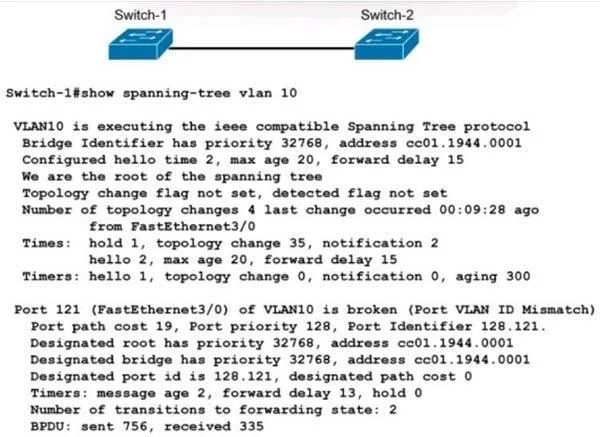
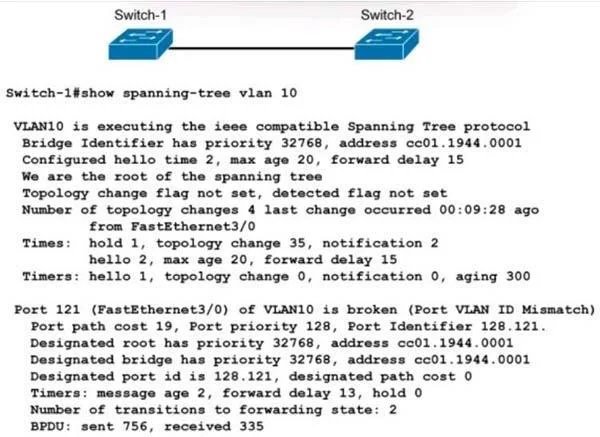
Refer to the exhibit. An engineer is troubleshooting a trunk link failure between Switch-1 and Switch-2. Which action will resolve this issue?
The correct answer is A. Configure the same native VLAN on both interfaces. A common cause of trunk link failure is a native VLAN mismatch between the two switches, which causes the trunk to become non-operational by blocking traffic or placing the port in an err-disabled state.
Question
Refer to the exhibit. An engineer is troubleshooting a trunk link failure between Switch-1 and Switch-2. Which action will resolve this issue?
Exhibits
Options
- AConfigure the same native VLAN on both interfaces
- BConfigure the same spanning tree mode on both switches
- CSet the same port speed on both switches
- DConfigure the same trunk mode on both switches
How the community answered
(24 responses)- A83% (20)
- B8% (2)
- C4% (1)
- D4% (1)
Why each option
A common cause of trunk link failure is a native VLAN mismatch between the two switches, which causes the trunk to become non-operational by blocking traffic or placing the port in an err-disabled state.
A mismatch in the native VLAN configuration on trunk interfaces between two switches is a critical issue that can cause the trunk link to fail or become non-operational, leading to traffic loss and potentially err-disabling the port due to control plane integrity issues.
While it is generally best practice to use consistent spanning tree modes, a mismatch in STP mode does not typically cause a trunk link to fail or become non-operational in the same direct manner as a native VLAN mismatch.
A port speed mismatch would prevent the physical link from establishing or cause it to operate poorly, which is a physical layer issue rather than a specific trunking protocol failure.
A trunk mode mismatch, such as one side being access mode while the other tries to trunk, would prevent the trunk from forming in the first place; however, a native VLAN mismatch can cause an already established or intended trunk to fail or be blocked.
Concept tested: Cisco trunking troubleshooting (native VLAN mismatch)
Source: https://www.cisco.com/c/en/us/support/docs/lan-switching/spanning-tree-protocol/10559-10.html
Topics
Community Discussion
No community discussion yet for this question.