
350-401 · Question #1035
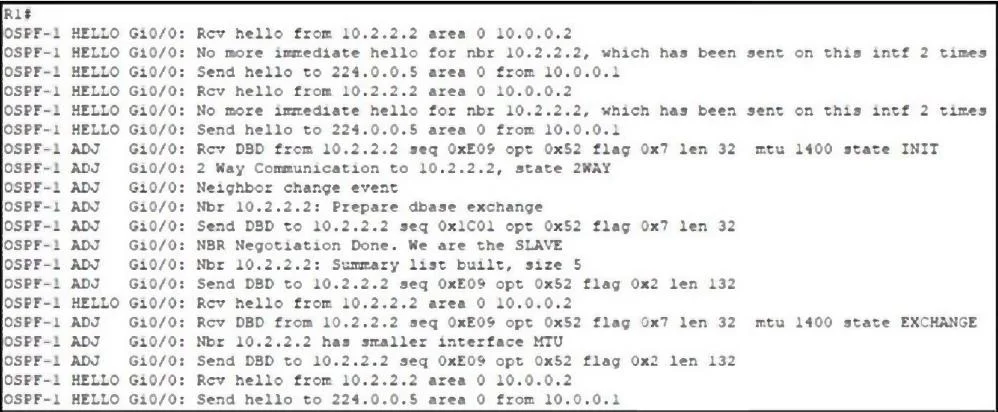
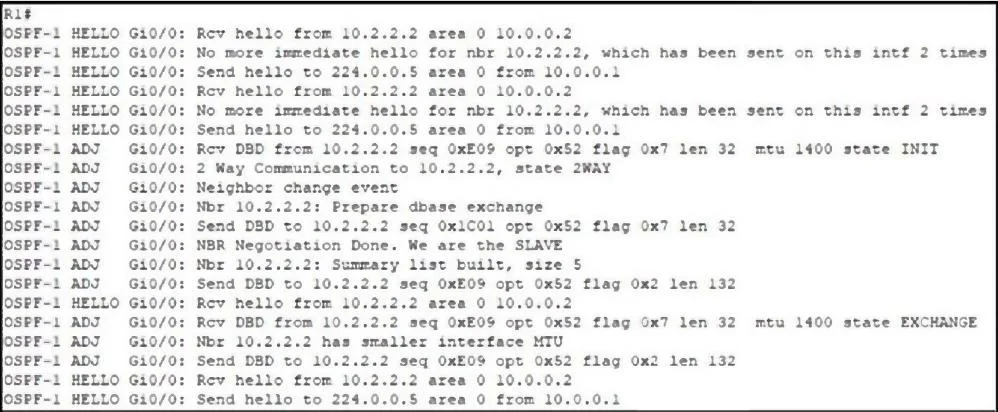
Refer to the exhibit. Two indirectly connected routers fail to form an OSPF neighborship. What is the cause of the issue?
The correct answer is C. MTU mismatch. An OSPF MTU mismatch between directly connected interfaces is a common reason for OSPF neighborship failure, causing the adjacency to get stuck in the EXSTART or EXCHANGE state.
Question
Refer to the exhibit. Two indirectly connected routers fail to form an OSPF neighborship. What is the cause of the issue?
Exhibits
Options
- Afailing hello packets between the two routers
- BDR/BDR selection dispute
- CMTU mismatch
- DOSPF network type mismatch
How the community answered
(19 responses)- A11% (2)
- B26% (5)
- C58% (11)
- D5% (1)
Why each option
An OSPF MTU mismatch between directly connected interfaces is a common reason for OSPF neighborship failure, causing the adjacency to get stuck in the EXSTART or EXCHANGE state.
Failing hello packets would prevent the neighborship from forming beyond the INIT state, which is an earlier stage than the EXSTART/EXCHANGE state often associated with MTU mismatches.
DR/BDR selection dispute could cause issues or delays, but an MTU mismatch directly prevents the DBD exchange necessary for full adjacency, which is a more fundamental problem for two routers trying to become full neighbors.
OSPF includes the interface MTU in its Database Description (DBD) packets. If the MTU values do not match between two OSPF neighbors on a directly connected link, they will fail to form a full adjacency and typically get stuck in the EXSTART/EXCHANGE state, preventing the exchange of routing information.
An OSPF network type mismatch (e.g., point-to-point vs. broadcast) can prevent neighborship formation, but an MTU mismatch is a specific and common cause that often results in the EXSTART/EXCHANGE state.
Concept tested: OSPF MTU mismatch issues
Source: https://www.cisco.com/c/en/us/support/docs/ip/open-shortest-path-first-ospf/13682-10.html#mtu
Topics
Community Discussion
No community discussion yet for this question.