
350-201 · Question #41
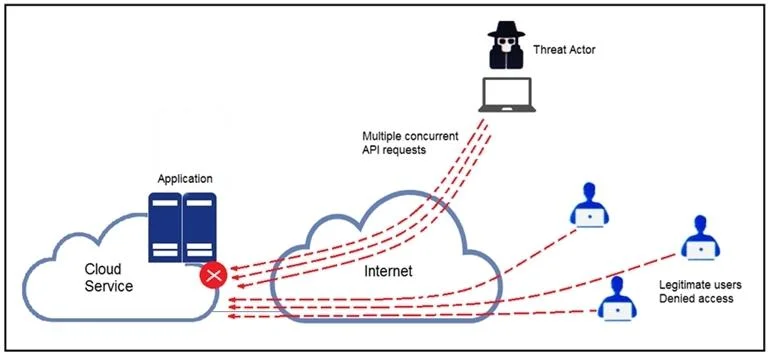
Refer to the exhibit. A threat actor behind a single computer exploited a cloud-based application by sending multiple concurrent API requests. These requests made the application unresponsive. Which…
The correct answer is A. Limit the number of API calls that a single client is allowed to make. This question tests knowledge of API rate limiting as the appropriate control to prevent a single client from overwhelming a cloud-based application with excessive concurrent requests.
Question
Refer to the exhibit. A threat actor behind a single computer exploited a cloud-based application by sending multiple concurrent API requests. These requests made the application unresponsive. Which solution protects the application from being overloaded and ensures more equitable application access across the end-user community?
Exhibit
Options
- ALimit the number of API calls that a single client is allowed to make
- BAdd restrictions on the edge router on how often a single client can access the API
- CReduce the amount of data that can be fetched from the total pool of active clients that call the
- DIncrease the application cache of the total pool of active clients that call the API
How the community answered
(29 responses)- A76% (22)
- B14% (4)
- C7% (2)
- D3% (1)
Why each option
This question tests knowledge of API rate limiting as the appropriate control to prevent a single client from overwhelming a cloud-based application with excessive concurrent requests.
Per-client API rate limiting restricts how many requests a single client (identified by IP, API key, or token) can make within a given time window. This directly addresses the threat of one actor monopolizing application resources by throttling that specific client, while still allowing other users equitable access - which is exactly the described scenario of a single computer sending concurrent requests.
Restrictions on an edge router would apply coarse network-level filtering but lack the application-layer context needed to enforce per-client API call limits intelligently and equitably.
Reducing the amount of data fetched from the total pool of active clients addresses bandwidth or data volume, not the rate of concurrent API calls from a single abusive client.
Increasing application cache improves performance for repeated read requests but does not limit or throttle any client's ability to send unlimited concurrent API calls.
Concept tested: API rate limiting to prevent resource exhaustion
Source: https://learn.microsoft.com/en-us/azure/architecture/patterns/rate-limiting-pattern
Topics
Community Discussion
No community discussion yet for this question.