
350-001 · Question #5
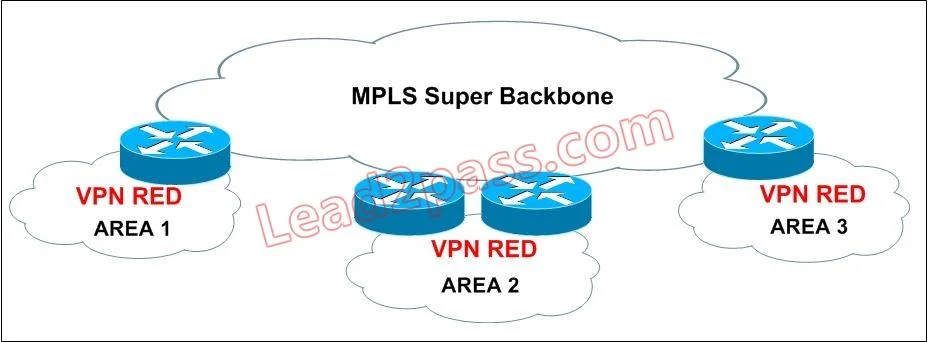
Refer to the exhibit. This is an MPLS VPN network with OSPF as the PE-CE routing protocol. Which statement is correct?
The correct answer is D. The routing inside the VPN RED will work without any special OSPF configuration. In MPLS VPN environments using OSPF as the PE-CE routing protocol, Cisco IOS implements a 'super backbone' mechanism. The PE routers act as OSPF ABRs, and the MPLS/BGP core emulates an OSPF Area 0 backbone between them. OSPF routes are carried across the VPN backbone in BGP…
Question
Refer to the exhibit. This is an MPLS VPN network with OSPF as the PE-CE routing protocol. Which statement is correct?
Exhibit
Options
- AThe routing inside the VPN RED will never work correctly.
- BThe routing inside the VPN RED can be enabled by configuring virtual links between the PE
- CThe routing inside the VPN RED can be enabled by configuring area 0 inside the VRF on the
- DThe routing inside the VPN RED will work without any special OSPF configuration.
- EThe routing inside the VPN RED will work if the PE routers have a full mesh of sham-links
How the community answered
(34 responses)- A6% (2)
- B15% (5)
- C6% (2)
- D71% (24)
- E3% (1)
Explanation
In MPLS VPN environments using OSPF as the PE-CE routing protocol, Cisco IOS implements a 'super backbone' mechanism. The PE routers act as OSPF ABRs, and the MPLS/BGP core emulates an OSPF Area 0 backbone between them. OSPF routes are carried across the VPN backbone in BGP using special extended communities (domain-ID, OSPF route-type, MED) that preserve OSPF attributes. When routes arrive at the remote PE, they are re-injected into OSPF with correct LSA types, making the routing transparent to CE routers. This works automatically without requiring sham-links (which are only needed to prefer the MPLS path over a backdoor OSPF link) or manual virtual links.
Topics
Community Discussion
No community discussion yet for this question.