
312-50V9 · Question #610
Switches maintain a CAM Table that maps individual MAC addresses on the network to physical ports on the switch. In MAC flooding attack, a switch is fed with many Ethernet frames, each containing…
The correct answer is A. Switch then acts as hub by broadcasting packets to all machines on the network. A MAC flooding attack exhausts the switch's CAM table memory, causing the switch to fail open and behave like a hub, forwarding frames out all ports.
Question
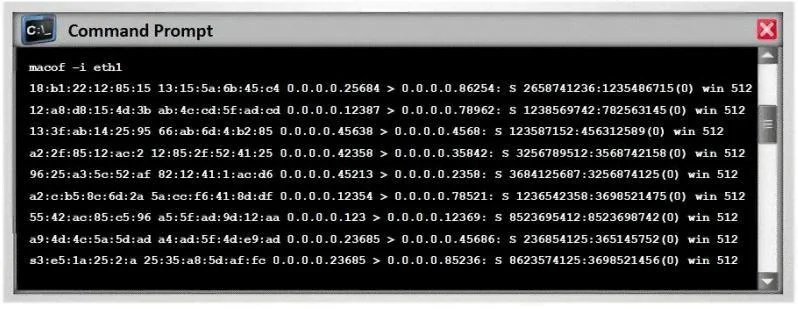
Switches maintain a CAM Table that maps individual MAC addresses on the network to physical ports on the switch. In MAC flooding attack, a switch is fed with many Ethernet frames, each containing different source MAC addresses, by the attacker. Switches have a limited memory for mapping various MAC addresses to physical ports. What happens when the CAM table becomes full?
Exhibit
Options
- ASwitch then acts as hub by broadcasting packets to all machines on the network
- BThe CAM overflow table will cause the switch to crash causing Denial of Service
- CThe switch replaces outgoing frame switch factory default MAC address of FF:FF:FF:FF:FF:FF
- DEvery packet is dropped and the switch sends out SNMP alerts to the IDS port
How the community answered
(25 responses)- A92% (23)
- C4% (1)
- D4% (1)
Why each option
A MAC flooding attack exhausts the switch's CAM table memory, causing the switch to fail open and behave like a hub, forwarding frames out all ports.
When a switch's CAM table is full, it can no longer learn new MAC-to-port mappings, so it defaults to flooding all incoming frames out every port except the one it arrived on - the same behavior as a hub. This is called 'fail-open' mode and allows an attacker connected to the same switch to capture traffic intended for other hosts using a packet sniffer.
A full CAM table does not crash the switch or cause a denial of service; the switch continues forwarding traffic, just inefficiently by broadcasting.
Switches do not replace frame destination addresses with the broadcast MAC FF:FF:FF:FF:FF:FF; that address is only used for legitimate broadcast frames, not as a fallback during table overflow.
Switches do not drop all packets or automatically generate SNMP alerts to an IDS port when the CAM table is full; packet dropping is not the fail-open behavior of commodity switches.
Concept tested: MAC flooding CAM table overflow behavior
Source: https://www.cisco.com/c/en/us/support/docs/lan-switching/8021q/17056-741-4.html
Topics
Community Discussion
No community discussion yet for this question.