
312-50V9 · Question #511
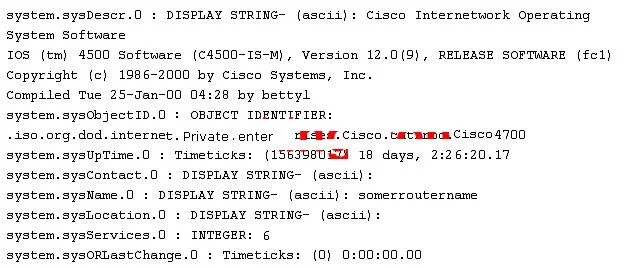
While reviewing the result of scanning run against a target network you come across the following: Which among the following can be used to get this output?
The correct answer is D. An SNMP walk. An SNMP walk traverses the Management Information Base (MIB) tree of a network device and returns a hierarchical listing of OIDs and their values. This type of structured, tree-formatted output is characteristic of SNMP enumeration.
Question
While reviewing the result of scanning run against a target network you come across the following:
Which among the following can be used to get this output?
Exhibit
Options
- AA Bo2k system query.
- Bnmap protocol scan
- CA sniffer
- DAn SNMP walk
How the community answered
(28 responses)- A4% (1)
- B11% (3)
- C4% (1)
- D82% (23)
Why each option
An SNMP walk traverses the Management Information Base (MIB) tree of a network device and returns a hierarchical listing of OIDs and their values. This type of structured, tree-formatted output is characteristic of SNMP enumeration.
A Back Orifice 2000 (Bo2k) system query returns remote administration data from a compromised Windows host, not a structured MIB-style enumeration output.
An Nmap protocol scan identifies which IP protocols a host supports (e.g., TCP, UDP, ICMP) and returns a list of open protocol numbers, not a hierarchical OID tree.
A sniffer passively captures raw network packets traversing the wire and does not generate active query output in the structured format described.
An SNMP walk uses the GetNextRequest operation to sequentially query all OIDs in a device's MIB tree, producing a structured output of variable bindings that lists system information, interfaces, and other managed objects - matching the described output format.
Concept tested: SNMP walk enumeration and MIB traversal
Source: https://docs.cisco.com/en/US/docs/ios/12_0s/feature/guide/snmp_mib.html
Topics
Community Discussion
No community discussion yet for this question.