
312-50V11 · Question #693
Switches maintain a CAM Table that maps individual MAC addresses on the network to physical ports on the switch. In MAC flooding attack, a switch is fed with many Ethernet frames, each containing…
The correct answer is A. Switch then acts as hub by broadcasting packets to all machines on the network. When a switch's CAM table is exhausted by a MAC flooding attack, the switch enters a fail-open state and broadcasts all frames to every port, effectively behaving like a hub.
Question
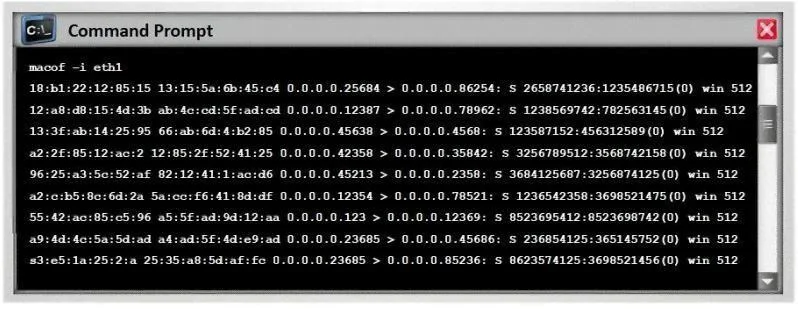
Switches maintain a CAM Table that maps individual MAC addresses on the network to physical ports on the switch. In MAC flooding attack, a switch is fed with many Ethernet frames, each containing different source MAC addresses, by the attacker. Switches have a limited memory for mapping various MAC addresses to physical ports. What happens when the CAM table becomes full?
Exhibit
Options
- ASwitch then acts as hub by broadcasting packets to all machines on the network
- BThe CAM overflow table will cause the switch to crash causing Denial of Service
- CThe switch replaces outgoing frame switch factory default MAC address of FF:FF:FF:FF:FF:FF
- DEvery packet is dropped and the switch sends out SNMP alerts to the IDS port
How the community answered
(16 responses)- A88% (14)
- B6% (1)
- D6% (1)
Why each option
When a switch's CAM table is exhausted by a MAC flooding attack, the switch enters a fail-open state and broadcasts all frames to every port, effectively behaving like a hub.
Standard switch behavior upon CAM table exhaustion is to flood frames out all ports because it can no longer make forwarding decisions based on destination MAC-to-port mappings. This fail-open behavior mirrors how an Ethernet hub operates, allowing an attacker connected to any port on the switch to capture all network traffic with a packet sniffer, which is the primary goal of a MAC flooding attack.
The switch does not crash or stop forwarding traffic upon CAM table overflow; it continues to operate in a degraded broadcast mode rather than halting, so a denial of service is not the direct result.
Switches do not overwrite frame destination MAC addresses with FF:FF:FF:FF:FF:FF in response to CAM overflow; that broadcast address is used in legitimate broadcast frames and is not inserted by the switch hardware during overflow.
Switches do not drop all packets or automatically generate SNMP alerts to an IDS port upon CAM table overflow; this is not part of the IEEE 802.1D standard switch forwarding behavior.
Concept tested: MAC flooding CAM table overflow switch fail-open behavior
Source: https://www.cisco.com/c/en/us/support/docs/lan-switching/ethernet/10556-cam-table.html
Topics
Community Discussion
No community discussion yet for this question.