
312-50V11 · Question #626
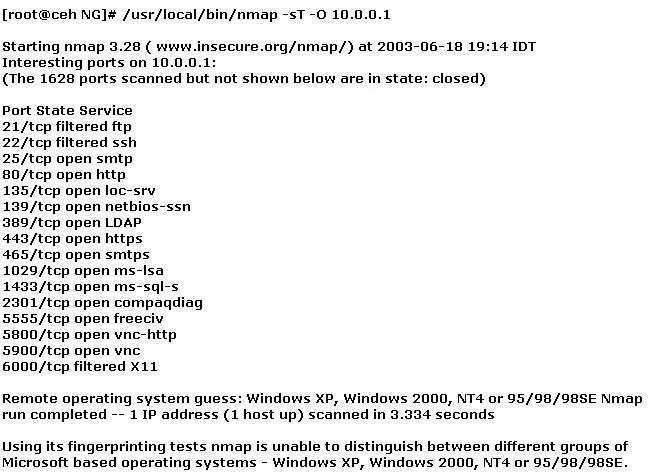
You have initiated an active operating system fingerprinting attempt with nmap against a target system: What operating system is the target host running based on the open ports shown above?
The correct answer is D. Windows 2000 Server. Nmap OS fingerprinting identifies Windows 2000 Server based on characteristic open TCP ports and TCP/IP stack behavior observed during active probing.
Question
You have initiated an active operating system fingerprinting attempt with nmap against a target system:
What operating system is the target host running based on the open ports shown above?
Exhibit
Options
- AWindows XP
- BWindows 98 SE
- CWindows NT4 Server
- DWindows 2000 Server
How the community answered
(70 responses)- A6% (4)
- B11% (8)
- C1% (1)
- D81% (57)
Why each option
Nmap OS fingerprinting identifies Windows 2000 Server based on characteristic open TCP ports and TCP/IP stack behavior observed during active probing.
Windows XP has a different TCP/IP stack fingerprint and typically exposes different default services than a Windows 2000 Server installation.
Windows 98 SE is a consumer desktop OS with a 16/32-bit hybrid stack that produces distinctly different fingerprint responses from a Windows 2000 Server system.
Windows NT4 Server predates Windows 2000 and has a different TCP/IP implementation with different default open ports and stack behavior.
Windows 2000 Server exposes a distinctive combination of open ports including 135 (RPC), 139 (NetBIOS), and 445 (SMB), along with a TCP/IP stack fingerprint unique to that OS version. Nmap's OS detection engine compares these probe responses against its fingerprint database to identify the OS. These port and stack characteristics differ sufficiently from Windows 9x and NT4 to produce a confident Windows 2000 Server match.
Concept tested: Nmap active OS fingerprinting via open port analysis
Source: https://nmap.org/book/osdetect.html
Topics
Community Discussion
No community discussion yet for this question.