
312-50V11 · Question #123
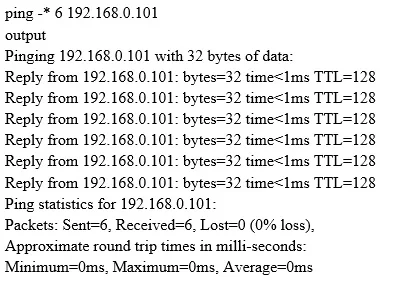
What does the option * indicate?
The correct answer is C. n. This question appears incomplete or missing surrounding context, but based on the answer choices (s, t, n, a) in a security exam context, it likely references nmap scan flags where the correct option represents a NULL scan (-sN).
Question
What does the option * indicate?
Exhibit
Options
- As
- Bt
- Cn
- Da
How the community answered
(18 responses)- B6% (1)
- C89% (16)
- D6% (1)
Why each option
This question appears incomplete or missing surrounding context, but based on the answer choices (s, t, n, a) in a security exam context, it likely references nmap scan flags where the correct option represents a NULL scan (-sN).
The option 's' corresponds to a SYN scan (-sS in nmap), which sends half-open SYN packets to identify open ports and is not representative of a wildcard or flagless option.
The option 't' corresponds to a TCP connect scan (-sT in nmap), which completes the full three-way TCP handshake and is distinct from any null or flagless scan type.
In nmap, the -sN flag designates a NULL scan, which sends TCP packets with no control flags set. The 'n' stands for NULL, meaning the probe carries no SYN, ACK, RST, FIN, PSH, or URG bits. A NULL scan can evade stateless packet filters that only inspect specific flag combinations, making port state inference possible without triggering standard SYN-based firewall rules.
The option 'a' corresponds to an ACK scan (-sA in nmap), which is used to probe firewall rulesets rather than identify open ports, and does not represent a null or wildcard scan type.
Concept tested: Nmap scan type flags including NULL scan
Source: https://nmap.org/book/man-port-scanning-techniques.html
Topics
Community Discussion
No community discussion yet for this question.