
312-50V10 · Question #216
Emil uses nmap to scan two hosts using this command: nmap -sS -T4 -O 192.168.99.1 192.168.99.7 He receives this output: What is his conclusion?
The correct answer is B. He performed a SYN scan and OS scan on hosts 192.168.99.1 and 192.168.99.7. The nmap command uses -sS for a TCP SYN scan and -O for OS fingerprinting on both target hosts, which is exactly what answer B describes.
Question
Emil uses nmap to scan two hosts using this command:
nmap -sS -T4 -O 192.168.99.1 192.168.99.7 He receives this output:
What is his conclusion?
Exhibit
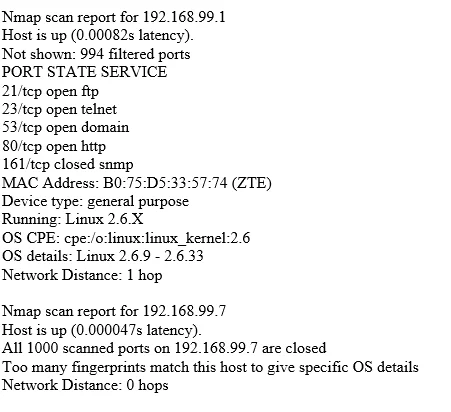
Options
- AHost 192.168.99.7 is an iPad.
- BHe performed a SYN scan and OS scan on hosts 192.168.99.1 and 192.168.99.7
- CHost 192.168.99.1 is the host that he launched the scan from.
- DHost 192.168.99.7 is down.
How the community answered
(22 responses)- A9% (2)
- B82% (18)
- C5% (1)
- D5% (1)
Why each option
The nmap command uses -sS for a TCP SYN scan and -O for OS fingerprinting on both target hosts, which is exactly what answer B describes.
OS detection in nmap relies on probabilistic TCP/IP stack fingerprinting and cannot definitively identify a device as an iPad without corroborating evidence from the actual output.
The -sS flag instructs nmap to perform a TCP SYN (half-open) scan by sending SYN packets and analyzing responses without completing the three-way handshake. The -O flag enables OS fingerprinting on both 192.168.99.1 and 192.168.99.7, while -T4 sets an aggressive timing template. These flags together confirm that a SYN scan and OS detection scan were performed on both listed hosts.
The source IP of the scanning host cannot be determined from the command syntax alone, and nmap does not mark the scanning host differently in its output by default.
Nothing in the command indicates host 192.168.99.7 is down; both hosts are explicitly listed as scan targets, and a down state would need to be confirmed from the actual output.
Concept tested: Nmap SYN scan and OS detection command flags
Source: https://nmap.org/book/man-os-detection.html
Topics
Community Discussion
No community discussion yet for this question.