
312-38 · Question #5
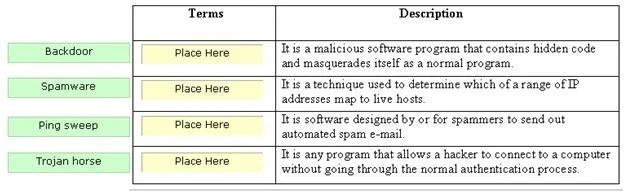
Drag and Drop Question Drag and drop the terms to match with their descriptions. Answer:
The correct answer is Backdoor; Spamware; Ping sweep; Trojan horse. Note on the Question Format The descriptions to match against are missing from what was provided - only the terms and their correct positions are shown. Based on the arrangement, here are the standard definitions these terms would be matched to: --- Term-by-Term Breakdown 1…
Question
Exhibit
Answer Area
Drag items
Correct arrangement
- Backdoor
- Spamware
- Ping sweep
- Trojan horse
Explanation
Note on the Question Format
The descriptions to match against are missing from what was provided - only the terms and their correct positions are shown. Based on the arrangement, here are the standard definitions these terms would be matched to:
Term-by-Term Breakdown
1. Backdoor
A covert method that bypasses normal authentication to gain persistent, unauthorized access to a system. It can be installed by malware, left intentionally by a developer, or planted by an attacker after initial compromise. Key trait: it survives reboots and allows re-entry without credentials.
Common misconception: Backdoors aren't always malicious by origin - some are accidentally left in by developers - but all are a security risk.
2. Spamware
Malware that hijacks an infected machine to send mass unsolicited email (spam). The infected host becomes part of a botnet used to distribute ads, phishing attempts, or more malware at scale without the owner's knowledge.
Common misconception: Spamware is often confused with adware. Adware shows you ads; spamware sends spam from you to others.
3. Ping Sweep
A network reconnaissance technique that sends ICMP echo requests (pings) to a range of IP addresses to discover which hosts are live/reachable. It's a pre-attack enumeration step, not malware itself.
Common misconception: Students sometimes confuse this with a port scan. A ping sweep identifies which hosts exist; a port scan identifies what services run on a known host.
4. Trojan Horse
Malware disguised as legitimate software that tricks a user into willingly installing it. Unlike a virus, it doesn't self-replicate. Once inside, it can drop backdoors, steal data, or provide remote access.
Common misconception: Trojans are often confused with viruses. The key distinction is deception + no self-replication - the user installs it voluntarily, believing it to be benign.
Key Distinguishing Pattern
| Term | Category | Requires User Action? |
|---|---|---|
| Backdoor | Access mechanism | No |
| Spamware | Malware (behavior) | No (post-infection) |
| Ping sweep | Recon technique | No (attacker tool) |
| Trojan horse | Malware (delivery) | Yes (user installs it) |
Topics
Community Discussion
No community discussion yet for this question.