
300-915 · Question #13
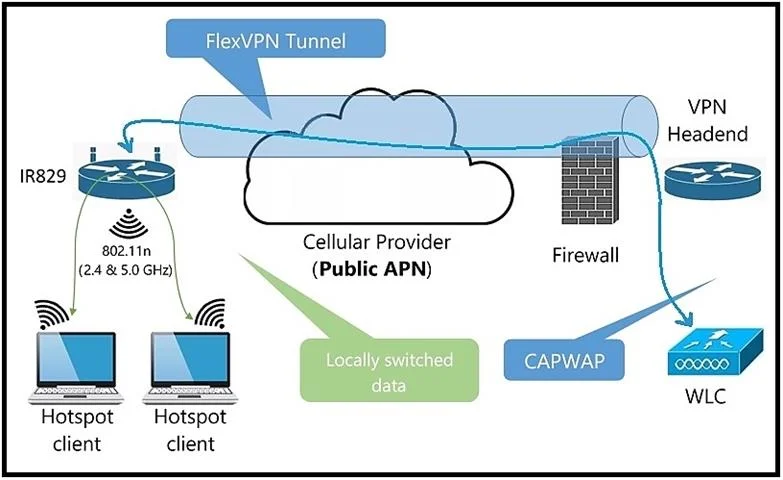
Refer to the exhibit. Which protocol is used to make a FlexVPN connection from a Cisco IR829 router to a headend router?
The correct answer is B. IKEv2. FlexVPN uses IKEv2 (Internet Key Exchange version 2) as its foundational protocol for establishing and securing VPN tunnels. Cisco's FlexVPN framework is built entirely on IKEv2, which handles authentication, key negotiation, and tunnel setup between the IR829 (a Cisco IoT…
Question
Refer to the exhibit. Which protocol is used to make a FlexVPN connection from a Cisco IR829 router to a headend router?
Exhibit
Options
- ASSL
- BIKEv2
- CNAT
- DIS-IS
How the community answered
(56 responses)- A2% (1)
- B91% (51)
- C5% (3)
- D2% (1)
Explanation
FlexVPN uses IKEv2 (Internet Key Exchange version 2) as its foundational protocol for establishing and securing VPN tunnels. Cisco's FlexVPN framework is built entirely on IKEv2, which handles authentication, key negotiation, and tunnel setup between the IR829 (a Cisco IoT router) and the headend - making B the only correct choice.
Why the distractors are wrong:
- A (SSL): SSL/TLS is used by Cisco's AnyConnect or WebVPN solutions, not FlexVPN. These are distinct VPN technologies.
- C (NAT): NAT is a network address translation mechanism, not a VPN protocol - it may co-exist with VPN tunnels but plays no role in establishing them.
- D (IS-IS): IS-IS is a link-state routing protocol used to exchange routing information, completely unrelated to VPN tunnel negotiation.
Memory tip: Think "Flex2VPN" - FlexVPN always pairs with IKEv2. If you see FlexVPN on a Cisco exam, IKEv2 is the answer, full stop.
Topics
Community Discussion
No community discussion yet for this question.