
300-820 · Question #96
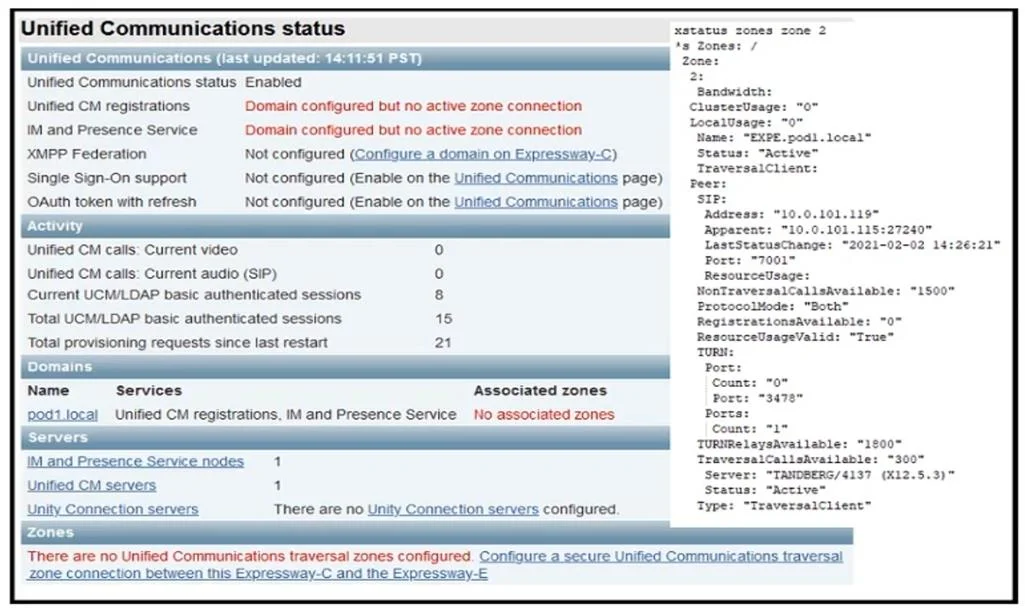
Refer to the exhibit. Logins and failing via mobile and remote access. How is this resolved?
The correct answer is D. Although a traversal client zone exists, there is no Unified Communications traversal client. For Mobile and Remote Access (MRA) to function, Expressway-C must have a Unified Communications (UC) traversal client zone configured - not just a standard traversal client zone. A regular traversal client zone handles generic H.323/SIP traversal but lacks the UC-specific logic…
Question
Refer to the exhibit. Logins and failing via mobile and remote access. How is this resolved?
Exhibit
Options
- AMobile and remote access login has not been enabled for the domain configured in the
- BSIP is disabled on the Expressway-E. The SIP protocol must be enabled on the server.
- CNo Cisco UCM servers are configured in the Expressway-C. Servers must be added for
- DAlthough a traversal client zone exists, there is no Unified Communications traversal client
How the community answered
(33 responses)- A9% (3)
- B3% (1)
- C6% (2)
- D82% (27)
Explanation
For Mobile and Remote Access (MRA) to function, Expressway-C must have a Unified Communications (UC) traversal client zone configured - not just a standard traversal client zone. A regular traversal client zone handles generic H.323/SIP traversal but lacks the UC-specific logic required for MRA (such as handling HTTP-based service discovery, provisioning, and directory lookups for Jabber). The UC traversal client zone is a specialized zone type that enables the full MRA feature set. If only a standard traversal client zone exists without the UC traversal client zone, MRA login will fail. The fix is to create and properly configure a UC traversal client zone on Expressway-C pointing to Expressway-E.
Topics
Community Discussion
No community discussion yet for this question.