
300-820 · Question #87
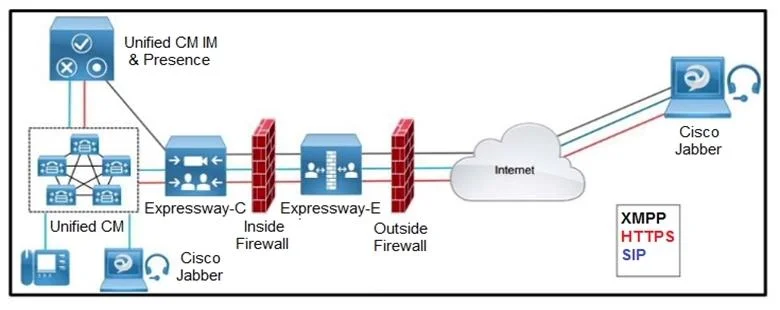
Refer to the exhibit. Which two outbound connections should an administrator configure on the internal firewall? (Choose two.)
The correct answer is A. XMPP: TCP 7400 B. SIP: TCP 7001. In a Cisco Expressway deployment, the internal firewall sits between the internal network (where Expressway-C resides) and the DMZ (where Expressway-E resides). Expressway-C initiates all outbound connections to Expressway-E - this is a core security design principle that…
Question
Refer to the exhibit. Which two outbound connections should an administrator configure on the internal firewall? (Choose two.)
Exhibit
Options
- AXMPP: TCP 7400
- BSIP: TCP 7001
- CSIP TCP 5061
- DMedia: UDP 36012 to 59999
- EHTTPS: TCP 8443
How the community answered
(32 responses)- A75% (24)
- C16% (5)
- D3% (1)
- E6% (2)
Explanation
In a Cisco Expressway deployment, the internal firewall sits between the internal network (where Expressway-C resides) and the DMZ (where Expressway-E resides). Expressway-C initiates all outbound connections to Expressway-E - this is a core security design principle that avoids inbound holes through the internal firewall. Two key outbound ports must be allowed: XMPP on TCP 7400, which carries Jabber instant messaging and presence traffic for Mobile and Remote Access (MRA) clients, and SIP on TCP 7001, which is the traversal zone signaling port used between Expressway-C and Expressway-E. SIP TCP 5061 (TLS) is used externally between Expressway-E and remote endpoints, not across the internal firewall. Media UDP ports (36012–59999) and HTTPS TCP 8443 are not required on the internal firewall for this traversal link.
Topics
Community Discussion
No community discussion yet for this question.