
300-820 · Question #190
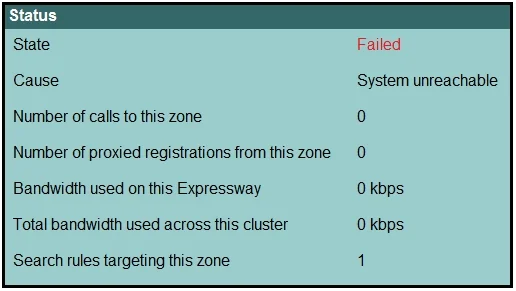
Refer to the exhibit. A company has a Cisco collaboration infrastructure that contains Cisco UCM and Cisco Expressway-C and Expressway-E for Mobile and Remote Access. When the engineer sets up the…
The correct answer is D. TCP for the incoming transport type. When configuring B2B calling, Expressway-C creates a SIP zone toward Cisco UCM. If the zone fails, a common cause is a transport type mismatch in the SIP Trunk Security Profile on UCM. The profile's 'incoming transport type' must match what Expressway-C is sending. Changing the…
Question
Refer to the exhibit. A company has a Cisco collaboration infrastructure that contains Cisco UCM and Cisco Expressway-C and Expressway-E for Mobile and Remote Access. When the engineer sets up the environment to support B2B calling, they discover that the zone stale between Expressway-C and Cisco UCM failed. What must the STEP Trunk Security Profile setting be changed to in Cisco UCM to resolve the issue?
Exhibit
Options
- AUDP for the outgoing transport type
- Bvalue other than the default listening port for outgoing SIP connections on Cisco UCM
- Cvalue other than the default listening port for incoming SIP connections on Cisco UCM
- DTCP for the incoming transport type
How the community answered
(39 responses)- A3% (1)
- C3% (1)
- D95% (37)
Explanation
When configuring B2B calling, Expressway-C creates a SIP zone toward Cisco UCM. If the zone fails, a common cause is a transport type mismatch in the SIP Trunk Security Profile on UCM. The profile's 'incoming transport type' must match what Expressway-C is sending. Changing the incoming transport type to TCP (instead of TLS or UDP) aligns the profile with how Expressway-C initiates the SIP connection on the internal network, resolving the zone establishment failure. The listening port defaults are typically correct; the transport type is the critical mismatch.
Topics
Community Discussion
No community discussion yet for this question.