
300-740 · Question #4
Refer to the exhibit. An engineer must provide HTTPS access from the Google Cloud Platform virtual machine to the on-premises mail server. All other connections from the virtual machine to the mail…
The correct answer is A. Set IP address 192.168.200.10 as the destination in rule 1. D. Configure a NAT rule. Fixing rule 1's destination to 192.168.200.10 (the mail server's on-premises IP) ensures the HTTPS permit rule targets the correct host, rather than applying too broadly or not matching at all - without this, the rule never matches traffic destined for the mail server. Adding a…
Question
Refer to the exhibit. An engineer must provide HTTPS access from the Google Cloud Platform virtual machine to the on-premises mail server. All other connections from the virtual machine to the mail server must be blocked. The indicated rules were applied to the firewall; however, the virtual machine cannot access the mail server. Which two actions should be performed on the firewall to meet the requirement? (Choose two.)
Exhibit
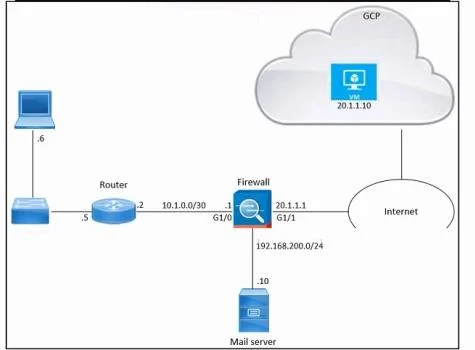
Options
- ASet IP address 192.168.200.10 as the destination in rule 1.
- BMove up rule 2.
- CSet IP address 20.1.1.1 as the source in rule 1.
- DConfigure a NAT rule.
- EConfigure a security group.
How the community answered
(59 responses)- A61% (36)
- B5% (3)
- C20% (12)
- E14% (8)
Explanation
Fixing rule 1's destination to 192.168.200.10 (the mail server's on-premises IP) ensures the HTTPS permit rule targets the correct host, rather than applying too broadly or not matching at all - without this, the rule never matches traffic destined for the mail server. Adding a NAT rule is necessary because the GCP virtual machine uses a private cloud IP that is not routable on the on-premises network; NAT translates the source address so the firewall and mail server can properly forward and return traffic.
B is wrong because moving rule 2 does not fix the misconfigured destination in rule 1 - reordering rules cannot correct a rule that is matching the wrong traffic in the first place. C is wrong because setting 20.1.1.1 as the source would restrict the rule to that specific IP, but the core problem is the missing destination specification, not the source; correcting the destination (A) is what enables the match. E is wrong because security groups are an AWS/GCP-native construct layered on instances, not a firewall rule fix - the question is asking about the perimeter firewall, where NAT and ACL destination fixes are the appropriate tools.
Memory tip: Think "destination + translation" - firewall permit rules need to know where traffic is going (correct destination IP), and cross-network traffic (cloud → on-premises) almost always needs NAT to bridge the address spaces.
Topics
Community Discussion
No community discussion yet for this question.