
300-720 · Question #70
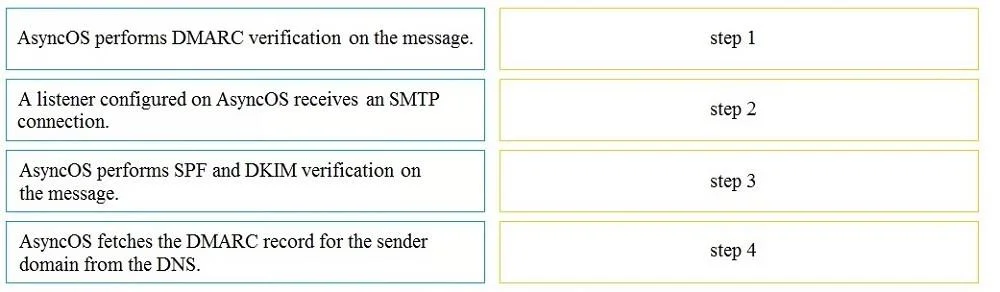
Drag and Drop Question Drag and drop the AsyncOS methods for performing DMARC verification from the left into the correct order on the right. Answer:
The correct answer is A listener configured on AsyncOS receives an SMTP connection.; AsyncOS fetches the DMARC record for the sender domain from the DNS.; AsyncOS performs SPF and DKIM verification on the message.; AsyncOS performs DMARC verification on the message. The question requires correctly ordering the steps an AsyncOS device takes to perform DMARC verification on an incoming email.
Question
Drag and Drop Question Drag and drop the AsyncOS methods for performing DMARC verification from the left into the correct order on the right. Answer:
Exhibit
Answer Area
Drag items
Correct arrangement
- A listener configured on AsyncOS receives an SMTP connection.
- AsyncOS fetches the DMARC record for the sender domain from the DNS.
- AsyncOS performs SPF and DKIM verification on the message.
- AsyncOS performs DMARC verification on the message.
Explanation
The question requires correctly ordering the steps an AsyncOS device takes to perform DMARC verification on an incoming email.
Approach. The correct interaction is to drag the text boxes from the left into the target slots on the right in the following order:
- 'A listener configured on AsyncOS receives an SMTP connection.' - This is the foundational first step, as DMARC verification (or any email processing) cannot begin until the email is received by the system via an SMTP connection.
- 'AsyncOS performs SPF and DKIM verification on the message.' - DMARC relies heavily on the outcomes of SPF (Sender Policy Framework) and DKIM (DomainKeys Identified Mail) checks. These authentications must be performed first to generate the results that DMARC will subsequently evaluate.
- 'AsyncOS fetches the DMARC record for the sender domain from the DNS.' - After performing SPF and DKIM checks, the system needs to retrieve the DMARC policy for the sender's domain. This policy, obtained from a DNS lookup, dictates how the SPF and DKIM results (and alignment) should be interpreted and what action (reject, quarantine, none) should be taken.
- 'AsyncOS performs DMARC verification on the message.' - This final step involves evaluating the SPF and DKIM results against the fetched DMARC policy and its alignment requirements. Based on this, AsyncOS makes a DMARC decision and applies the configured action to the email.
Common mistakes.
- common_mistake. A common mistake would be to fetch the DMARC record before performing SPF and DKIM verification. While DMARC is a policy found in DNS, its purpose is to instruct how to handle the results of SPF and DKIM. Therefore, SPF and DKIM must be verified first to produce the results that DMARC will then evaluate. Another mistake might be placing 'AsyncOS performs DMARC verification' too early. DMARC verification is the final decision-making step, relying on all prior authentication results and policy lookups.
Concept tested. The underlying technical concept being tested is the sequential process and operational flow of DMARC (Domain-based Message Authentication, Reporting, and Conformance) verification, including its dependency on SPF (Sender Policy Framework) and DKIM (DomainKeys Identified Mail) in an email security gateway context, specifically Cisco AsyncOS.
Topics
Community Discussion
No community discussion yet for this question.