
300-720 · Question #149
Drag and Drop Question Drag and drop the graymail descriptions from the left onto the verdict categories they belong to on the right. Answer:
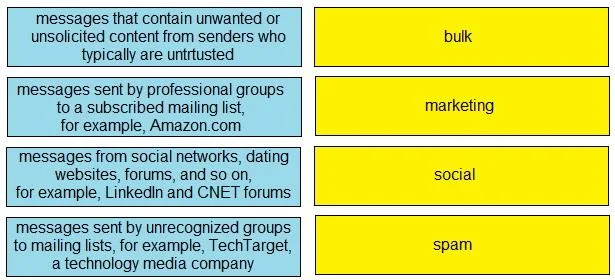
The correct answer is messages that contain unwanted or unsolicited content from senders who typically are untrusted; messages sent by professional groups to a subscribed mailing list, for example, Amazon.com; messages from social networks, dating websites, forums, and so on, for example, LinkedIn and CNET forums; messages sent by unrecognized groups to mailing lists, for example, TechTarget, a technology media company. The question requires matching descriptions of different types of 'graymail' or unsolicited email to their correct classification categories, testing knowledge of email security and filtering terminology.
Question
Drag and Drop Question Drag and drop the graymail descriptions from the left onto the verdict categories they belong to on the right. Answer:
Exhibit
Answer Area
Drag items
Correct arrangement
- messages that contain unwanted or unsolicited content from senders who typically are untrusted
- messages sent by professional groups to a subscribed mailing list, for example, Amazon.com
- messages from social networks, dating websites, forums, and so on, for example, LinkedIn and CNET forums
- messages sent by unrecognized groups to mailing lists, for example, TechTarget, a technology media company
Explanation
The question requires matching descriptions of different types of 'graymail' or unsolicited email to their correct classification categories, testing knowledge of email security and filtering terminology.
Approach. The correct interaction is to drag each blue description box to its appropriate yellow category box based on the standard definitions and examples provided:
-
Drag 'messages that contain unwanted or unsolicited content from senders who typically are untrusted' to 'spam'.
- Reasoning: This is the quintessential definition of spam - unsolicited, often malicious or deceptive, and from untrusted sources.
-
Drag 'messages sent by professional groups to a subscribed mailing list, for example, Amazon.com' to 'marketing'.
- Reasoning: These are commercial communications from established organizations, often sent to individuals who have opted into a mailing list, even if they sometimes feel like 'graymail' if not actively engaged with.
-
Drag 'messages from social networks, dating websites, forums, and so on, for example, LinkedIn and CNET forums' to 'social'.
- Reasoning: This category specifically covers notifications, updates, or messages originating from social media platforms, dating sites, or online forums.
-
Drag 'messages sent by unrecognized groups to mailing lists, for example, TechTarget, a technology media company' to 'bulk'.
- Reasoning: Bulk mail refers to high-volume emails, often newsletters, promotional content, or industry updates, which may be legitimate but are sent broadly and might not be explicitly desired by all recipients. The 'unrecognized groups' aspect often contributes to a 'bulk' classification, distinguishing it from explicit marketing a user opted into, or malicious spam.
Common mistakes.
- common_mistake. A common mistake is confusing 'bulk' with 'spam' or 'marketing'. While all can be unsolicited to some degree, 'spam' implies malicious intent, deception, or highly untrusted sources. 'Marketing' typically comes from recognized entities to subscribed users. 'Bulk' sits in between - often legitimate content from a sender (like TechTarget), but sent widely and perhaps without explicit, strong recipient intent, making it 'graymail' that a user might not actively want, but isn't necessarily harmful. Forgetting that social media notifications have their own distinct 'social' category is also a potential error, leading to misclassification into bulk or marketing.
Concept tested. The underlying technical concept being tested is the classification and understanding of different types of 'graymail' or unsolicited email, which is fundamental to email security, spam filtering, and email client configuration (e.g., in Microsoft 365 Exchange Online Protection). It assesses the ability to distinguish between spam, bulk mail, marketing emails, and social notifications based on their content, sender, and typical recipient interaction.
Topics
Community Discussion
No community discussion yet for this question.