
300-710 · Question #372
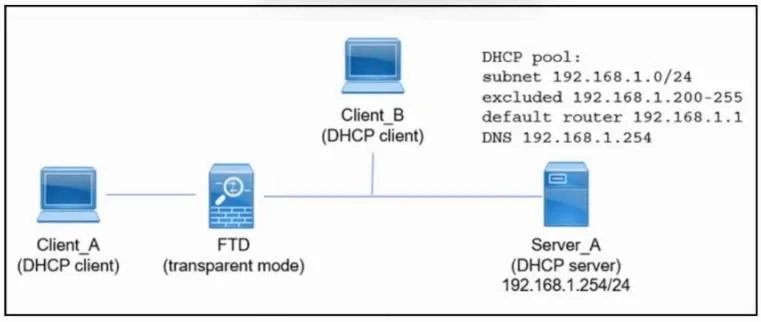
Refer to the exhibit. An engineer is deploying a new instance of Cisco Secure Firewall Threat Defense. Which action must the engineer take next so that Client_A and Client_B receive an IP address…
The correct answer is D. Add access rules that allow DHCP traffic by using Cisco Secure Firewall Management Center. For features that are not directly supported on the transparent firewall, you can allow traffic to pass through so that upstream and downstream routers can support the functionality. For example, by using an access rule, you can allow DHCP traffic (instead of the unsupported…
Question
Refer to the exhibit. An engineer is deploying a new instance of Cisco Secure Firewall Threat Defense. Which action must the engineer take next so that Client_A and Client_B receive an IP address via DHCP from Server_A?
Exhibit
Options
- ADisable all the DHCP Snort rules by using Secure Firewall Device Manager.
- BAdd another DHCP pool on Server_A with DHCP relay on Secure Firewall Threat Defense.
- CDisable Option 82 in the DHCP relay configuration properties using Secure Firewall Management
- DAdd access rules that allow DHCP traffic by using Cisco Secure Firewall Management Center.
How the community answered
(25 responses)- A4% (1)
- B4% (1)
- C12% (3)
- D80% (20)
Explanation
For features that are not directly supported on the transparent firewall, you can allow traffic to pass through so that upstream and downstream routers can support the functionality. For example, by using an access rule, you can allow DHCP traffic (instead of the unsupported DHCP relay feature) or multicast traffic such as that created by IP/TV. guide-v70/transparent_or_routed_firewall_mode_for_firepower_threat_defense.html
Topics
Community Discussion
No community discussion yet for this question.