
300-625 · Question #66
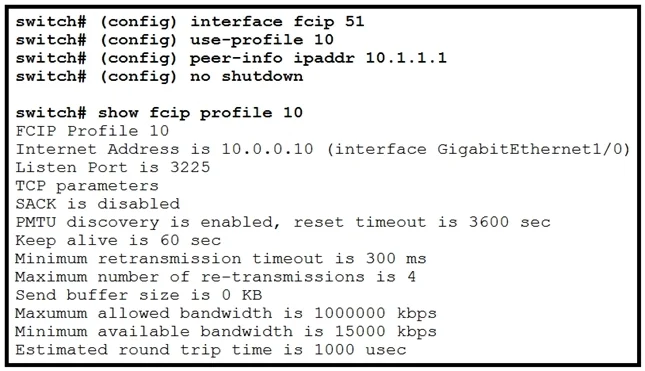
Refer to the exhibit. Which configuration change improves the ability of the link to recover from frame loss?
The correct answer is B. Enable selective acknowledgment. Selective Acknowledgment (SACK) allows the receiver to inform the sender exactly which packets were received and which were lost, so only the missing frames are retransmitted - not everything after the gap. Without SACK, standard TCP cumulative ACKs force the sender to…
Question
Refer to the exhibit. Which configuration change improves the ability of the link to recover from frame loss?
Exhibit
Options
- AIncrease the reset timeout.
- BEnable selective acknowledgment.
- CIncrease the send buffer size to 15000 KB.
- DDisable PMTU discovery.
How the community answered
(31 responses)- A6% (2)
- B77% (24)
- C13% (4)
- D3% (1)
Explanation
Selective Acknowledgment (SACK) allows the receiver to inform the sender exactly which packets were received and which were lost, so only the missing frames are retransmitted - not everything after the gap. Without SACK, standard TCP cumulative ACKs force the sender to retransmit all frames from the point of loss onward, even those already received successfully, severely degrading throughput after any loss event.
Option A (increasing reset timeout) delays how long the connection waits before resetting, which actually slows recovery rather than improving it. Option C (larger send buffer) increases the volume of in-flight data, which can worsen loss recovery since more data may need retransmitting when a loss occurs. Option D (disabling PMTU discovery) would cause fragmentation by sending oversized packets, which increases the likelihood of frame loss rather than recovering from it.
Memory tip: Think of SACK as a "surgical strike" - instead of carpet-bombing retransmissions, it precisely targets only the dropped frames. If the question mentions frame loss recovery or retransmission efficiency, SACK is almost always the answer.
Topics
Community Discussion
No community discussion yet for this question.