
300-620 · Question #291
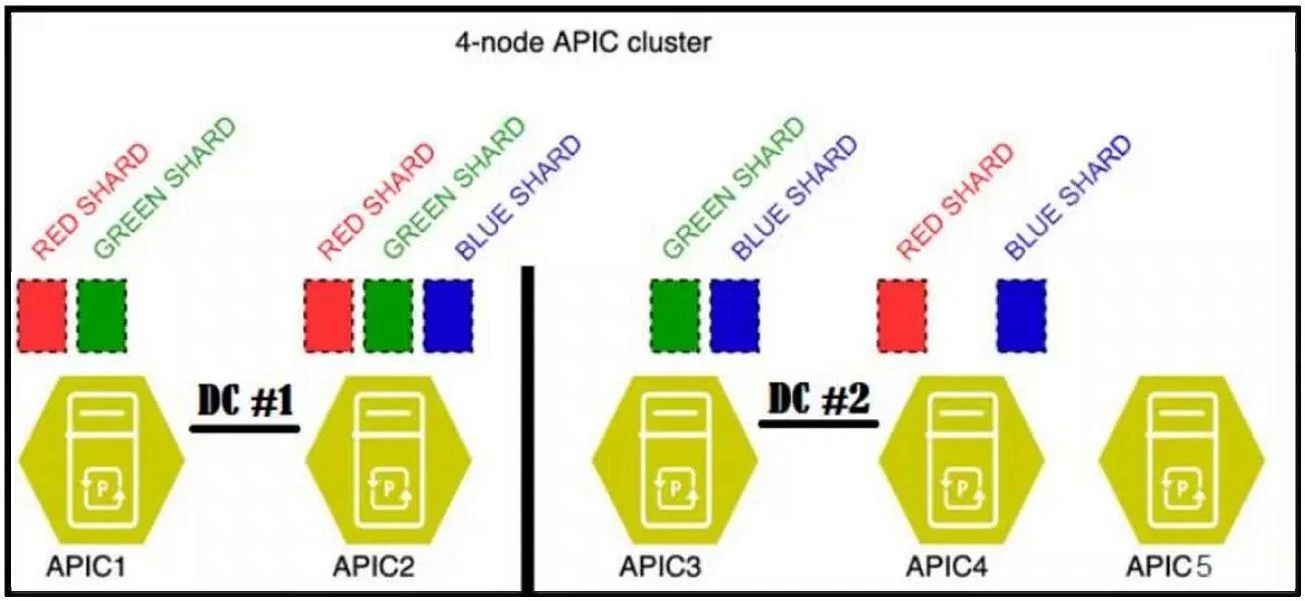
Refer to the exhibit. A four-node APIC cluster is deployed across two data centers. What happens to the database shards when DC1 with APIC1 and APIC2 fail?
The correct answer is C. The blue shard remains in read-write mode, and green and red are in read-only mode. When DC1 fails, taking APIC1 and APIC2 offline, the APIC cluster loses overall quorum for election (2 of 4 nodes remain). Consequently, shards whose primary copies were on the failed APICs (green and red) become read-only, while the blue shard, with its primary on a surviving…
Question
Refer to the exhibit. A four-node APIC cluster is deployed across two data centers. What happens to the database shards when DC1 with APIC1 and APIC2 fail?
Exhibit
Options
- AThe blue shard remains in read-write mode, and green and red are inaccessible.
- BThe blue shard becomes primary, and green and red are standby.
- CThe blue shard remains in read-write mode, and green and red are in read-only mode.
- DThe red shard becomes primary, and blue and red are standby.
How the community answered
(52 responses)- A33% (17)
- B10% (5)
- C42% (22)
- D15% (8)
Why each option
When DC1 fails, taking APIC1 and APIC2 offline, the APIC cluster loses overall quorum for election (2 of 4 nodes remain). Consequently, shards whose primary copies were on the failed APICs (green and red) become read-only, while the blue shard, with its primary on a surviving APIC, remains in read-write mode.
If green and red were inaccessible, it implies no replicas are available or even read-only access is impossible, which is not necessarily the case when replicas exist on surviving APICs.
The blue shard would remain primary, but green and red cannot become standby; they would either be read-only or inaccessible due to primary loss and lack of quorum for election.
In a 4-node APIC cluster, losing two nodes (APIC1 and APIC2) means the cluster lacks the necessary quorum (3 nodes) for full operational capability and new primary elections. The blue shard's primary must reside on a surviving APIC (APIC3 or APIC4), allowing it to remain in read-write mode. However, the green and red shards, having lost their primary instances in the failed DC1, cannot elect new primaries due to insufficient quorum and thus become accessible only in read-only mode from their surviving replicas.
The red shard cannot become primary because its primary node failed, and with only two APICs remaining, there is insufficient quorum to elect a new primary for the red shard.
Concept tested: APIC cluster database sharding quorum
Source: https://www.cisco.com/c/en/us/td/docs/dcn/aci/apic/5x/installation/b_Cisco_APIC_Installation_Guide_5x/b_Cisco_APIC_Installation_Guide_5x_chapter_01.html
Topics
Community Discussion
No community discussion yet for this question.