
300-620 · Question #186
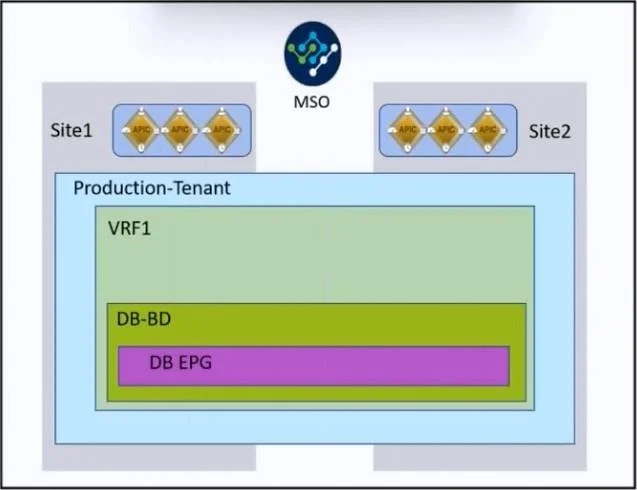
Refer to the exhibit. An engineer must allow IP mobility between Site1 and Site2 in a Cisco ACI Multi- Site orchestrator. The design must meet these requirements: - A disaster recovery (DR) solution…
The correct answer is D. Disable Inter-site BUM Traffic. E. Apply the L2 Stretch feature. To achieve IP mobility between Cisco ACI Multi-Site fabrics for disaster recovery without vMotion, requiring no re-IP, and avoiding broadcast storms, specific L2 stretching and BUM traffic management configurations are necessary.
Question
Refer to the exhibit. An engineer must allow IP mobility between Site1 and Site2 in a Cisco ACI Multi- Site orchestrator. The design must meet these requirements:
- A disaster recovery (DR) solution must exist between the sites that
do not require vMotion support.
- The application must be started at a DR site without having to re-IP
the application servers.
- The solution must avoid any broadcast storms between the sites.
Which two actions meet these criteria? (Choose two.)
Exhibit
Options
- ADefine a unique bridge domain subnet per site.
- BConfigure STP between Cisco ACI fabrics.
- CDeploy a local EPG for Site1 and Site2.
- DDisable Inter-site BUM Traffic.
- EApply the L2 Stretch feature.
How the community answered
(27 responses)- A11% (3)
- B4% (1)
- C19% (5)
- D67% (18)
Why each option
To achieve IP mobility between Cisco ACI Multi-Site fabrics for disaster recovery without vMotion, requiring no re-IP, and avoiding broadcast storms, specific L2 stretching and BUM traffic management configurations are necessary.
Defining a unique bridge domain subnet per site would prevent IP mobility between sites without re-IP, as each site would have its own distinct Layer 3 subnet, which contradicts the requirement for no re-IP.
Configuring STP between Cisco ACI fabrics is generally not recommended or supported for inter-fabric Layer 2 stretched links; ACI handles its own loop prevention within the fabric and relies on IP routing for inter-fabric communication or specific MAC address move handling for L2 stretch.
Deploying a local EPG for Site1 and Site2 is a standard way to define endpoints within each site, but it doesn't inherently provide the L2 stretching capability for IP mobility or address BUM traffic management between sites.
Disabling Inter-site BUM Traffic is essential to prevent broadcast storms across stretched Layer 2 networks in a Multi-Site deployment, which is a critical requirement for network stability. This ensures that unknown unicast, broadcast, and multicast traffic does not traverse the inter-site link unnecessarily, addressing the requirement to avoid broadcast storms.
Applying the L2 Stretch feature within Cisco ACI Multi-Site Orchestrator enables the extension of a Layer 2 network (Bridge Domain) across different ACI fabrics, allowing IP mobility between sites without having to re-IP application servers during a disaster recovery event and without requiring vMotion.
Concept tested: ACI Multi-Site L2 stretch and BUM traffic
Source: https://www.cisco.com/c/en/us/td/docs/dcn/aci/apic/5x/multi-site/cisco-aci-multi-site-architecture-white-paper-5x.html
Topics
Community Discussion
No community discussion yet for this question.