
300-615 · Question #45
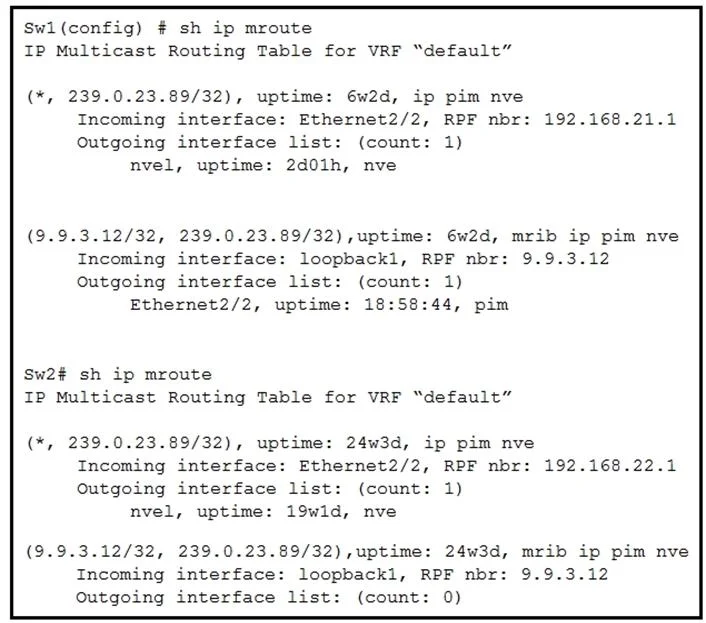
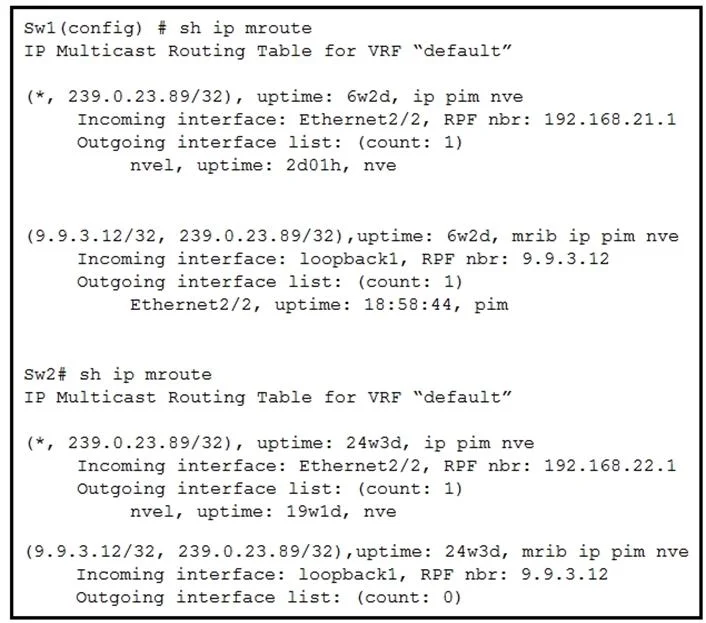
Refer to the exhibit. Sw1 and Sw2 are two Cisco Nexus 9000 Series Switches that run Cisco NX- OS. They are VTEPs in the same vPC domain. Which statement describes what happens in this scenario?
The correct answer is B. Sw1 performs the VxLAN multicast encapsulation and decapsulation for all traffic associated with. In a vPC + VXLAN multicast environment, when Sw2 has not joined the multicast group (as shown in the exhibit), it cannot perform VXLAN multicast encapsulation or decapsulation. Sw1 - which has successfully joined the group and built a valid OIF (Outgoing Interface) list - takes…
Question
Refer to the exhibit. Sw1 and Sw2 are two Cisco Nexus 9000 Series Switches that run Cisco NX- OS. They are VTEPs in the same vPC domain. Which statement describes what happens in this scenario?
Exhibits
Options
- ASw1 drops all traffic because there is no (S, G) OIF list to encapsulate VXLAN multicast packets
- BSw1 performs the VxLAN multicast encapsulation and decapsulation for all traffic associated with
- CSw1 and switch 2 perform the VxLAN multicast encapsulation and decapsulation for all traffic
- DSw2 did not send an IP PIM register to the rendezvous point for the multicast group of the VXLAN
How the community answered
(32 responses)- A6% (2)
- B75% (24)
- C3% (1)
- D16% (5)
Explanation
In a vPC + VXLAN multicast environment, when Sw2 has not joined the multicast group (as shown in the exhibit), it cannot perform VXLAN multicast encapsulation or decapsulation. Sw1 - which has successfully joined the group and built a valid OIF (Outgoing Interface) list - takes sole responsibility for encapsulating and decapsulating all BUM (Broadcast, Unknown Unicast, Multicast) traffic, including traffic arriving from Sw2 via the vPC peer link.
Why distractors are wrong:
- A is wrong because Sw1 does have a valid OIF list and active multicast group membership - it has everything it needs to forward traffic, so it will not drop it.
- C is wrong because only Sw1 has joined the multicast group; Sw2 lacks the multicast state required to participate in encapsulation/decapsulation.
- D is a plausible-sounding distractor but misidentifies the problem - PIM Register messages are sent by a first-hop router when a source begins sending; the actual issue here is Sw2's failure to join the group as a receiver (IGMP/PIM Join), not a missing PIM Register.
Memory tip: Think "one peer, one job" - in a vPC pair, if one VTEP is missing multicast group membership, its partner becomes the sole multicast forwarder for the entire domain. Traffic still crosses the peer link; it just gets encapsulated on the side that actually joined.
Community Discussion
No community discussion yet for this question.