
300-615 · Question #183
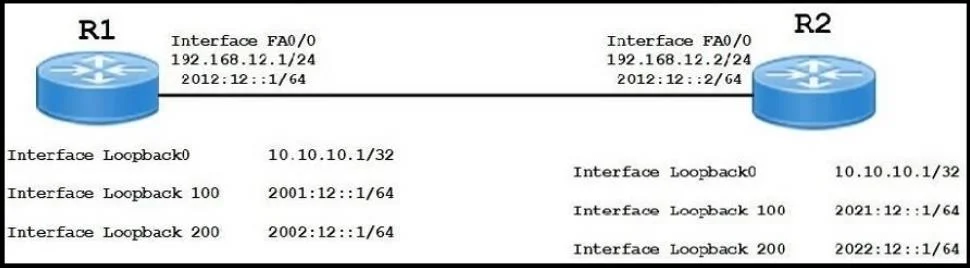
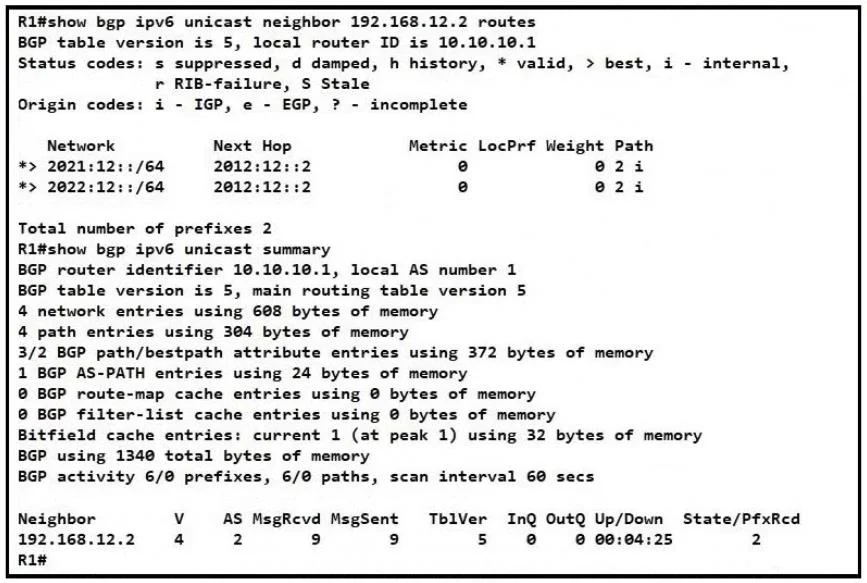
Refer to the exhibit. A network engineer must use BGP to route IPv4 and IPv6 routes between R1 and R2. The IPv4 addresses are exchanged as expected between the routers through BGP. The routers have…
The correct answer is A. Create a route map that sets the IPv6 next hop. Option A is correct because when BGP is established using IPv4 transport (as indicated by the working IPv4 exchange), IPv6 prefixes are carried as MP-BGP NLRI but the IPv6 next-hop attribute is typically unset or invalid - a route map configured with set ipv6 next-hop resolves…
Question
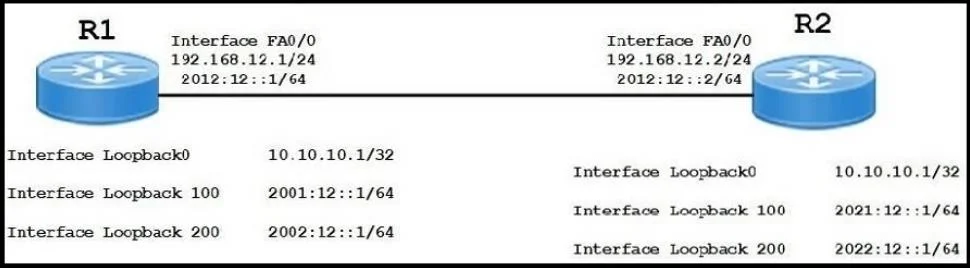
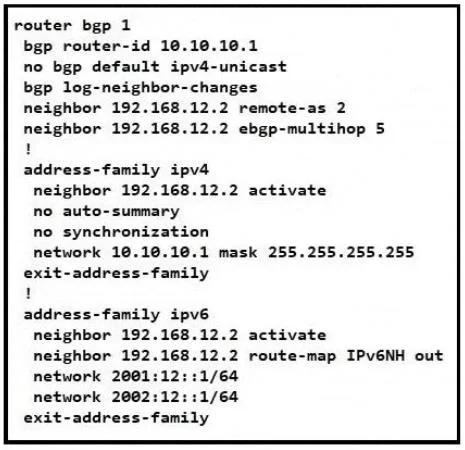
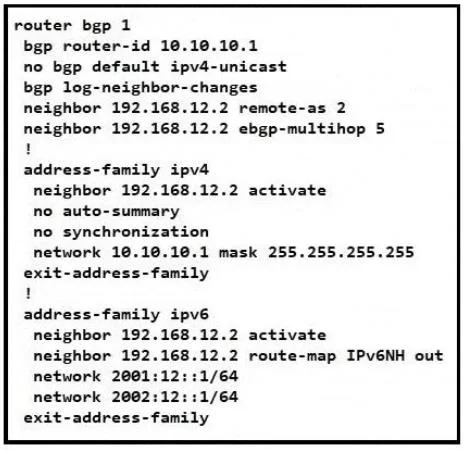
Refer to the exhibit. A network engineer must use BGP to route IPv4 and IPv6 routes between R1 and R2. The IPv4 addresses are exchanged as expected between the routers through BGP. The routers have reached an Established BGP state. However, the IPv6 routes from R2 fail to show in the routing table of R1. Which action resolves the issue?
Exhibits
Options
- ACreate a route map that sets the IPv6 next hop.
- BAdvertise L2VPN EVPN under IPv4 unicast address family
- CConfigure an IPv6 BGP neighbor on R1
- DEnable IPv6 routing on R1
How the community answered
(64 responses)- A77% (49)
- B6% (4)
- C14% (9)
- D3% (2)
Explanation
Option A is correct because when BGP is established using IPv4 transport (as indicated by the working IPv4 exchange), IPv6 prefixes are carried as MP-BGP NLRI but the IPv6 next-hop attribute is typically unset or invalid - a route map configured with set ipv6 next-hop resolves this by supplying a valid next-hop so R1 can install the routes.
Option C is wrong because a BGP neighbor relationship already exists (the session is in Established state); configuring an additional IPv6-addressed neighbor would create a redundant session, not fix the next-hop issue on the existing one. Option D is wrong because IPv6 routing is enabled by default on modern IOS and is not the reason routes are absent from the table - the routes are received via BGP but discarded due to an invalid next-hop, not because IPv6 forwarding is off. Option B is wrong because L2VPN EVPN is an address family used for overlay/VXLAN environments and is entirely unrelated to basic IPv4/IPv6 unicast BGP routing.
Memory tip: "IPv4 session + IPv6 routes = next-hop gap." When a single IPv4-transport BGP session carries IPv6 NLRI, always suspect a missing or zeroed-out IPv6 next-hop - the fix is a route map, not a new neighbor or a routing toggle.
Community Discussion
No community discussion yet for this question.