
300-615 · Question #176
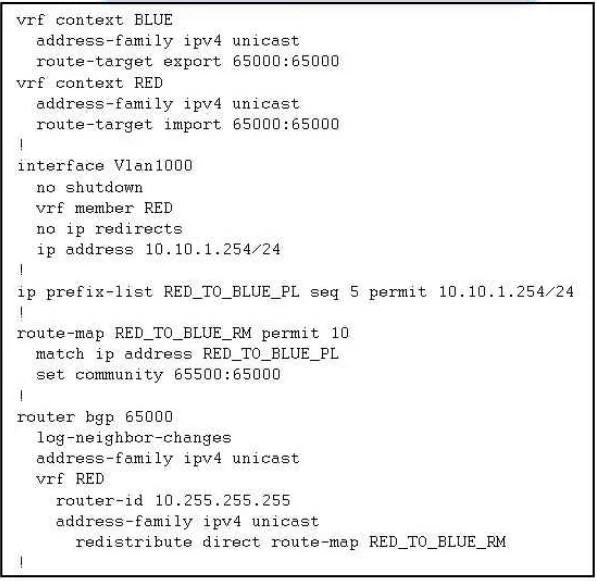
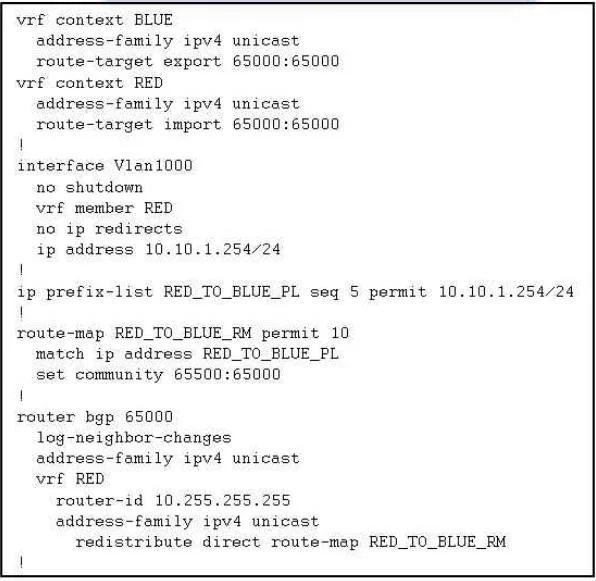
Refer to the exhibit. The expected routes are not being leaked as expected from VRF RED to VRF BLUE. Which action resolves the issue?
The correct answer is D. Set the community to 65000:65000 under the route map. Setting the community attribute to 65000:65000 in the route map is the fix because VRF BLUE's import policy is almost certainly filtering routes using a community match condition - if the redistributed routes from VRF RED don't carry that community value, the import route map…
Question
Refer to the exhibit. The expected routes are not being leaked as expected from VRF RED to VRF BLUE. Which action resolves the issue?
Exhibits
Options
- AInclude the "le 32" knob under the RED_TO_BLUE_ACL prefix list.
- BChange the route targets under the VRFs.
- CConfigure VRF BLUE under the BGP configuration.
- DSet the community to 65000:65000 under the route map.
How the community answered
(33 responses)- A3% (1)
- B12% (4)
- C9% (3)
- D76% (25)
Explanation
Setting the community attribute to 65000:65000 in the route map is the fix because VRF BLUE's import policy is almost certainly filtering routes using a community match condition - if the redistributed routes from VRF RED don't carry that community value, the import route map in VRF BLUE drops them before they can be installed, which is exactly the symptom described.
Why the distractors are wrong:
- A - Adding
le 32to the prefix list broadens the matched prefixes, but if the community isn't set, those routes are still rejected by VRF BLUE's import policy; the filter isn't the prefix list. - B - Route targets (RT import/export) drive MPLS/VPN route leaking in a traditional L3VPN context; if RTs were misconfigured, no routes would be exchanged at all, not the selective leak failure shown here.
- C - VRF BLUE is already referenced in the BGP configuration (its import policy is evaluating routes); adding it again changes nothing about why community-tagged routes are absent.
Memory tip: Think "community = passport." When leaking routes between VRFs with route maps, the sending VRF must stamp the passport (set the community) that the receiving VRF's import policy expects to see - no stamp, no entry.
Community Discussion
No community discussion yet for this question.