
300-615 · Question #157
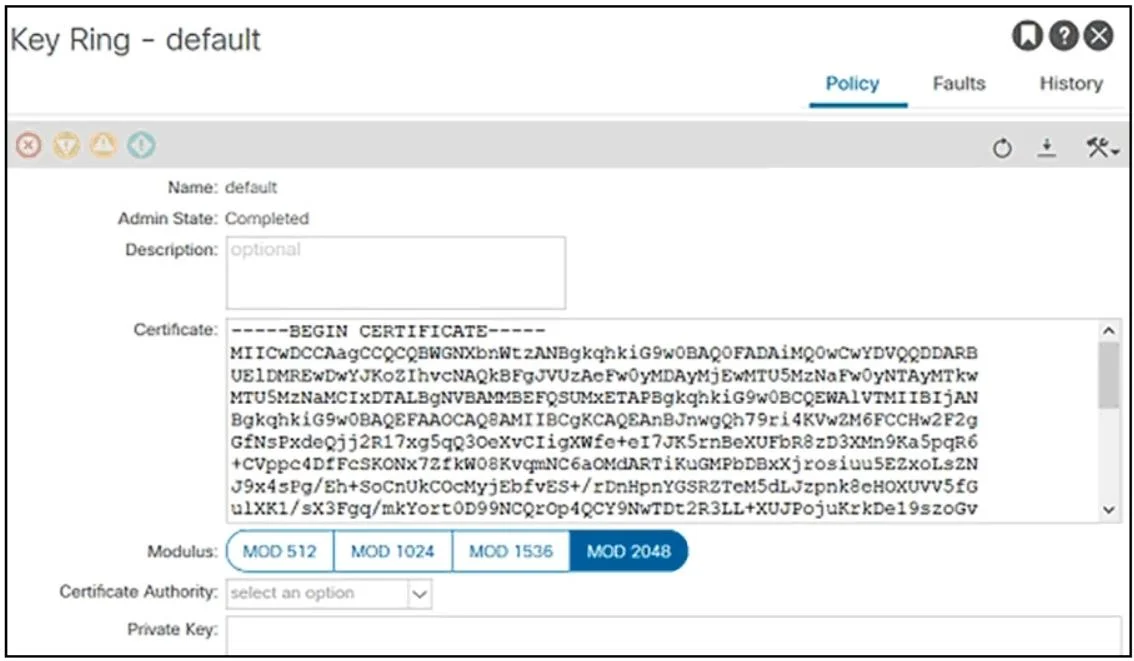
Refer to the exhibit. A certificate is implemented on the security configuration on the Cisco ACI controller. A customer receives a "Connection Not Secure" error in a browser every time the customer…
The correct answer is A. Include a private key with the certificate. Option A is correct because a TLS certificate requires both the public certificate and the corresponding private key for the HTTPS handshake to complete. When a certificate is uploaded to the Cisco APIC without its private key, the controller cannot establish an encrypted…
Question
Refer to the exhibit. A certificate is implemented on the security configuration on the Cisco ACI controller. A customer receives a "Connection Not Secure" error in a browser every time the customer logs in to the Cisco APIC GUI. Which action resolves the issue?
Exhibits
Options
- AInclude a private key with the certificate.
- BUse a browser that supports keys of 2048 bits.
- CConfigure a corporate certificate authority for the certificate.
- DAdd a 1536-bit key to the APIC GUI.
How the community answered
(26 responses)- A73% (19)
- B8% (2)
- C15% (4)
- D4% (1)
Explanation
Option A is correct because a TLS certificate requires both the public certificate and the corresponding private key for the HTTPS handshake to complete. When a certificate is uploaded to the Cisco APIC without its private key, the controller cannot establish an encrypted session, causing browsers to display "Connection Not Secure."
Why the distractors are wrong:
- B is wrong because 2048-bit key support is standard in all modern browsers; the issue here is a missing key, not key size compatibility.
- C is wrong because a corporate CA would address an untrusted certificate warning (the browser doesn't recognize the issuer), not a broken TLS handshake caused by a missing private key.
- D is wrong because 1536-bit is not a recognized standard key length for APIC certificates, and adding a non-standard key size does not fix a missing private key problem.
Memory tip: Think of a certificate as a padlock and the private key as the only key that opens it - you can display the padlock publicly, but without the private key, no secure connection can be "unlocked." If APIC is missing the private key, the door never opens, regardless of how trusted or large the lock is.
Community Discussion
No community discussion yet for this question.