
300-615 · Question #114
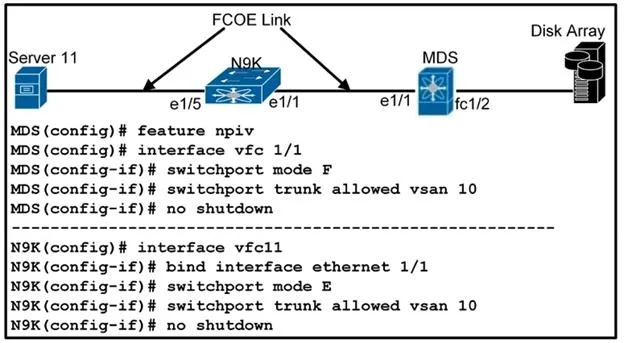
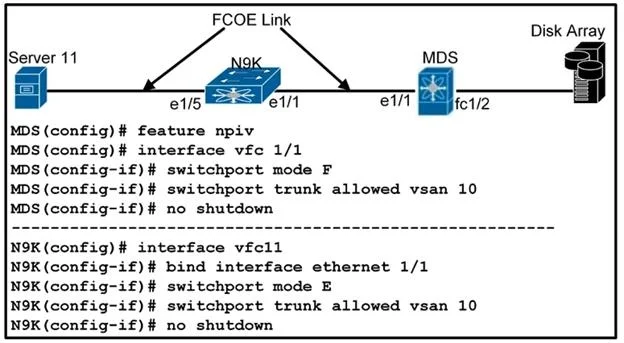
Refer to the exhibit. A network engineer is configuring the FCoE N_Port virtualization storage area network. After the initial implementation, server 11 fails to connect to the disk array. Which…
The correct answer is D. On N9K interface vfc11 and MDS interface vfc 1/1, change switchport mode configuration to E. In a full FCoE fabric with N_Port ID Virtualization (NPIV), the link between the Nexus 9K and the MDS is an Inter-Switch Link (ISL), and ISLs require E (Expansion) mode on both ends to allow the switches to exchange fabric services and route traffic between server 11 and the…
Question
Refer to the exhibit. A network engineer is configuring the FCoE N_Port virtualization storage area network. After the initial implementation, server 11 fails to connect to the disk array. Which action resolves the issue?
Exhibits
Options
- AOn MDS interface vfc 1/1, change switchport mode configuration to VF
- BOn N9K interface vfc11, change switchport mode configuration to NP
- COn N9K interface vfc11 and MDS interface vfc 1/1, change switchport mode configuration to F
- DOn N9K interface vfc11 and MDS interface vfc 1/1, change switchport mode configuration to E
How the community answered
(34 responses)- A12% (4)
- B3% (1)
- C3% (1)
- D82% (28)
Explanation
In a full FCoE fabric with N_Port ID Virtualization (NPIV), the link between the Nexus 9K and the MDS is an Inter-Switch Link (ISL), and ISLs require E (Expansion) mode on both ends to allow the switches to exchange fabric services and route traffic between server 11 and the disk array - setting only one side or using the wrong mode breaks the ISL and isolates server 11.
Option A is wrong because VF mode is for VSAN trunking between switches and only addresses one side of the link, leaving the ISL in a mismatched state. Option B is wrong because NP mode is specific to NPV (N_Port Proxy) uplinks, where a downstream switch acts as a proxy - not applicable when N9K is a full fabric participant forming a peer ISL. Option C is wrong because F (Fabric) mode is reserved for edge ports that face end devices (servers and storage HBAs), so configuring ISL ports as F mode prevents the switches from recognizing each other as fabric peers.
Memory tip: Think E for Exchange between switches - any time two full-fabric FC/FCoE switches need to form an ISL, both sides must be E mode. Reserve F for "facing end devices," NP for "NPV proxy uplinks," and VF for "Virtual Fabric trunking."
Community Discussion
No community discussion yet for this question.