
300-540 · Question #41
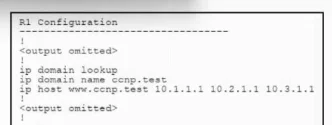
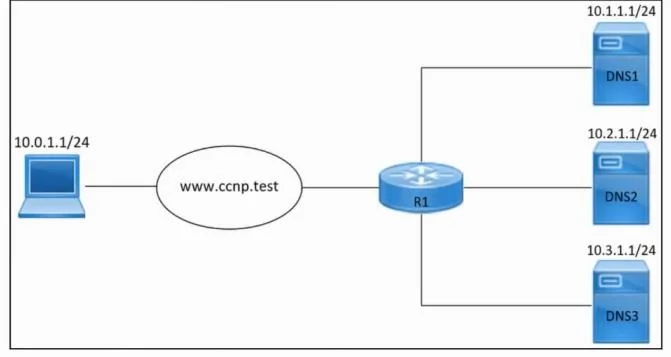
Refer to the exhibit. An engineer must configure Cisco IOS SLB for DNS on router R1 to meet these requirements: must be redirected to the DNS server at 10.1.1.1; must be redirected to the DNS server…
The correct answer is B. ip domain round-robin. On R1 the configuration (simplified) is: ip domain lookup ip domain name ccnp.test default, Cisco IOS will always return these IP addresses to DNS queries in the same order they are configured (10.1.1.1, then 10.2.1.1, then 10.3.1.1). This means that clients will always attempt…
Question
Refer to the exhibit. An engineer must configure Cisco IOS SLB for DNS on router R1 to meet these requirements:
must be redirected to the DNS server at 10.1.1.1; must be redirected to the DNS server at 10.2.1.1; must be redirected to the DNS server at 10.3.1.1. In each case, the other two addresses must also be attempted if the first one fails. The indicated configuration was applied to R1; however, the load balancing failed. Which command must be run on R1 to resolve the issue?
Exhibits
Options
- Aip domain retry 3
- Bip domain round-robin
- Cip dns server
- Dmaximum-paths 3
How the community answered
(35 responses)- A9% (3)
- B77% (27)
- C3% (1)
- D11% (4)
Explanation
On R1 the configuration (simplified) is: ip domain lookup ip domain name ccnp.test default, Cisco IOS will always return these IP addresses to DNS queries in the same order they are configured (10.1.1.1, then 10.2.1.1, then 10.3.1.1). This means that clients will always attempt 10.1.1.1 first and will not achieve per-query load balancing across all three servers. To enable DNS-based load balancing so that each successive query rotates the order of the addresses, Cisco IOS provides the command: ip domain round-robin This command enables round-robin rotation of multiple A records associated with a single hostname defined by ip host. With this feature enabled: 1st query: response order 10.1.1.1, 10.2.1.1, 10.3.1.1 2nd query: response order 10.2.1.1, 10.3.1.1, 10.1.1.1 3rd query: response order 10.3.1.1, 10.1.1.1, 10.2.1.1 Clients will typically try the first IP address in the list and use the others if the first one fails, exactly matching the requirement.
Topics
Community Discussion
No community discussion yet for this question.