
300-430 · Question #262
Refer to the exhibit. An enterprise uses 802.11 b/g APs and must track the RFID tags within the network. How many channels must be used to maximize the optimization of the monitoring and tracking of…
The correct answer is C. 4. For optimal RFID tag tracking with 802.11 b/g monitor-mode APs, Cisco recommends scanning 4 channels to maximize detection coverage and location accuracy.
Question
Refer to the exhibit. An enterprise uses 802.11 b/g APs and must track the RFID tags within the network. How many channels must be used to maximize the optimization of the monitoring and tracking of the tags?
Exhibit
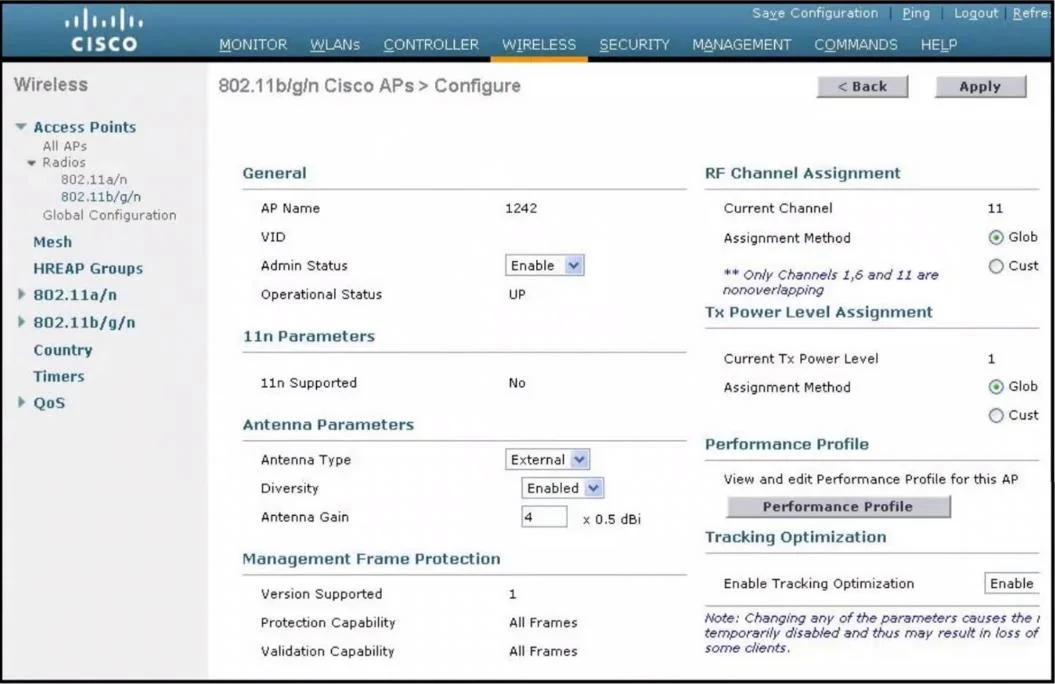
Options
- A1
- B3
- C4
- D11
How the community answered
(27 responses)- B4% (1)
- C89% (24)
- D7% (2)
Why each option
For optimal RFID tag tracking with 802.11 b/g monitor-mode APs, Cisco recommends scanning 4 channels to maximize detection coverage and location accuracy.
Monitoring only 1 channel provides extremely limited RF coverage and would miss RFID tag transmissions occurring on any other channel.
3 channels correspond to the standard non-overlapping set (1, 6, 11) but Cisco's RFID optimization guidance specifies 4 channels for maximum tag tracking performance.
Cisco's Context Aware Services and location tracking documentation specifies that monitor-mode APs used for RFID tracking should scan 4 channels in the 2.4 GHz band. While 802.11 b/g has 3 standard non-overlapping channels (1, 6, 11), adding a 4th channel increases scanning density and dwell coverage needed for accurate RFID tag triangulation, maximizing both detection probability and location precision.
Scanning all 11 channels introduces heavily overlapping channel coverage, which degrades tracking efficiency and location accuracy rather than optimizing it.
Concept tested: RFID tag tracking channel optimization with 802.11 b/g monitor APs
Source: https://www.cisco.com/c/en/us/td/docs/wireless/mse/3350/8-0/Context_Aware_Software_Configuration_Guide/b_MSE_CAS_8_0.html
Topics
Community Discussion
No community discussion yet for this question.