
300-425 · Question #85
An engineer changed me TPC Power Threshold for a wireless deployment from the default value to 65 dBm. The engineer conducts a new post deployment survey to validate the results. What is the…
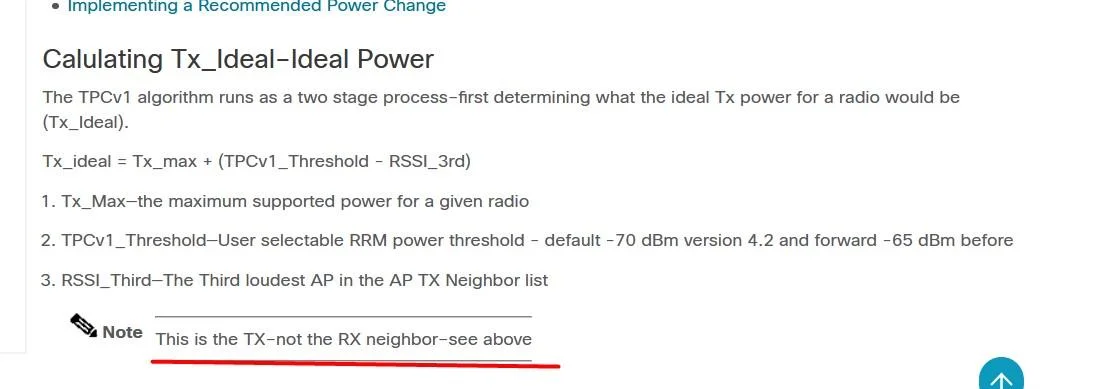
The correct answer is D. increased cell size. Increasing the TPC Power Threshold causes APs to raise their transmit power, which expands their RF coverage area and results in larger cell sizes.
Question
An engineer changed me TPC Power Threshold for a wireless deployment from the default value to 65 dBm. The engineer conducts a new post deployment survey to validate the results. What is the expected outcome?
Exhibit
Options
- Aincreased received sensitivity
- Bdecreased channel overlap
- Cdecreased client signal strength
- Dincreased cell size
How the community answered
(54 responses)- A15% (8)
- B4% (2)
- C9% (5)
- D72% (39)
Why each option
Increasing the TPC Power Threshold causes APs to raise their transmit power, which expands their RF coverage area and results in larger cell sizes.
Received sensitivity is a fixed hardware property of the radio chipset and cannot be altered by TPC or any software power configuration.
Raising AP transmit power increases cell size, which causes more cell overlap between neighboring APs, not less.
Increasing AP transmit power raises the received signal strength for clients within range, which is the opposite of decreasing it.
The TPC Power Threshold defines the target RSSI that neighboring APs should hear each other at. Increasing this value (e.g., from -70 dBm to -65 dBm) forces the RRM algorithm to instruct APs to raise their transmit power to satisfy the new threshold. Higher transmit power causes RF signals to propagate farther, directly increasing the cell size of each AP.
Concept tested: TPC Power Threshold effect on cell size
Source: https://www.cisco.com/c/en/us/td/docs/wireless/controller/technotes/8-3/b_RRM_White_Paper/b_RRM_White_Paper_chapter_0100.html
Topics
Community Discussion
No community discussion yet for this question.