
300-425 · Question #2
Which statement about AP failover priority for access points when configured with priority 1 or 4 is true?
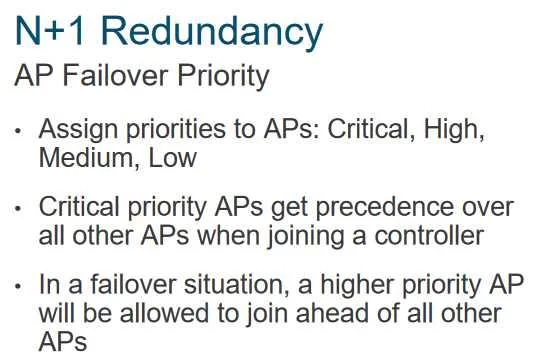
The correct answer is B. When configured with priority 4, the access point is assigned with the highest priority level and it. In Cisco WLC AP failover priority, the numeric scale is inverted from intuition - priority 4 is critical and highest, while priority 1 is low and lowest.
Question
Which statement about AP failover priority for access points when configured with priority 1 or 4 is true?
Exhibit
Options
- AWhen configured with priority 1, the access point is assigned with the highest priority level and it
- BWhen configured with priority 4, the access point is assigned with the highest priority level and it
- CWhen configured with priority 4, the access point is assigned with the lowest priority level and it is
- DWhen configured with priority 1, the access point is assigned with the medium priority level and it
How the community answered
(65 responses)- A8% (5)
- B86% (56)
- C5% (3)
- D2% (1)
Why each option
In Cisco WLC AP failover priority, the numeric scale is inverted from intuition - priority 4 is critical and highest, while priority 1 is low and lowest.
Priority 1 maps to 'low,' the lowest priority level, not the highest - the scale is highest at 4, not 1.
Cisco WLC uses a 1-4 priority scale where priority 4 maps to 'critical,' the highest failover priority level. When a controller fails, APs with priority 4 are serviced first and are most likely to successfully associate to a backup WLC. Priority 1 is the lowest level and those APs are last to be accommodated.
Priority 4 is the highest priority level (critical), not the lowest - this reverses the correct mapping.
Priority 1 maps to 'low,' not 'medium' - medium corresponds to priority 2 in the Cisco WLC priority scale.
Concept tested: Cisco WLC AP failover priority levels
Source: https://www.cisco.com/c/en/us/support/docs/wireless/4400-series-wireless-lan-controllers/107606-AP-failover-priority.html
Topics
Community Discussion
No community discussion yet for this question.