
300-425 · Question #12
An engineer is reducing the subnet size of the corporate WLAN by segmenting the VLAN into smaller subnets. Clients will be assigned a subnet by location. Which type of groups can the engineer use to…
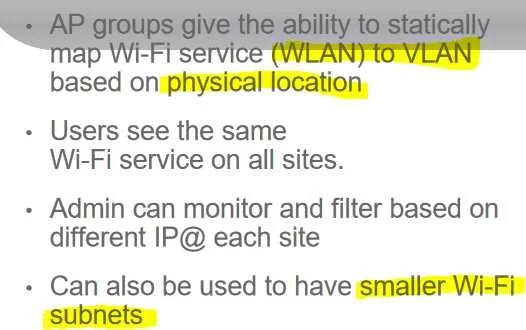
The correct answer is C. AP groups. AP groups allow an engineer to override WLAN-to-interface mappings on a per-location basis, enabling different subnets to be assigned to clients based on which group of APs they associate with.
Question
An engineer is reducing the subnet size of the corporate WLAN by segmenting the VLAN into smaller subnets. Clients will be assigned a subnet by location. Which type of groups can the engineer use to map the smaller subnets to the corporate WLAN?
Exhibit
Options
- AWLC port groups
- BRF groups
- CAP groups
- Dinterface groups
How the community answered
(21 responses)- B5% (1)
- C90% (19)
- D5% (1)
Why each option
AP groups allow an engineer to override WLAN-to-interface mappings on a per-location basis, enabling different subnets to be assigned to clients based on which group of APs they associate with.
WLC port groups are not a valid Cisco WLC construct for mapping subnets to WLANs by location.
RF groups are used for coordinating radio resource management across controllers and have no effect on VLAN or subnet assignments.
AP groups on a Cisco WLC allow administrators to assign a different interface (VLAN/subnet) for the same WLAN depending on which AP group the client's AP belongs to. By placing APs in location-specific AP groups and mapping each group to its corresponding smaller subnet interface, clients receive location-appropriate IP addressing without requiring separate WLANs.
Interface groups aggregate multiple dynamic interfaces for client load balancing across subnets, not for mapping distinct subnets to specific physical locations.
Concept tested: AP groups for location-based VLAN subnet assignment
Source: https://www.cisco.com/c/en/us/td/docs/wireless/controller/8-5/config-guide/b_cg85/ap_groups.html
Topics
Community Discussion
No community discussion yet for this question.