
300-420 · Question #335
Refer to the exhibit. An architect must design an OSPF solution for an enterprise customer. The design must meet these requirements: - Limit the link flap impact to Area-1 and Area-2. - Any link…
The correct answer is A. Enable manual route summarization and configure all nonbackbone areas as stub networks E. Tune LSA and SPF throttling timers. To limit the impact of OSPF link flaps and ensure minimal disruption to voice/video traffic, the design must include manual route summarization with stub areas and tuning LSA/SPF throttling timers.
Question
Refer to the exhibit. An architect must design an OSPF solution for an enterprise customer. The design must meet these requirements:
- Limit the link flap impact to Area-1 and Area-2.
- Any link failure must have minimal impact on voice and video traffic
Which two OSPF solutions must the architect include in the design? (Choose two.)
Exhibit
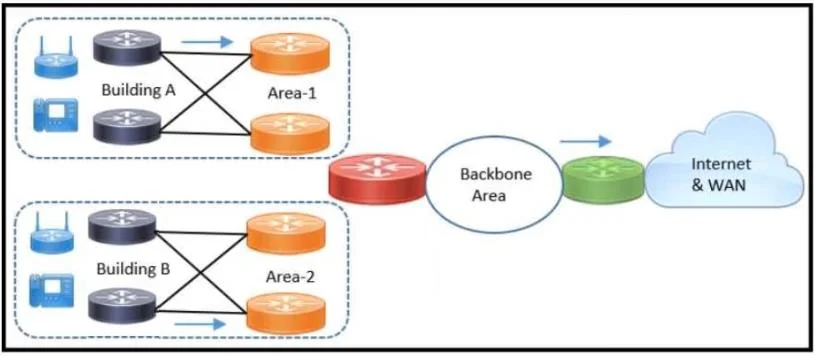
Options
- AEnable manual route summarization and configure all nonbackbone areas as stub networks
- BAdvertise default routes from the backbone to nonbackbone areas
- CReduce the frequency of DR and BDR elections
- DIncrease hello and hold timers
- ETune LSA and SPF throttling timers
How the community answered
(24 responses)- A75% (18)
- B4% (1)
- C17% (4)
- D4% (1)
Why each option
To limit the impact of OSPF link flaps and ensure minimal disruption to voice/video traffic, the design must include manual route summarization with stub areas and tuning LSA/SPF throttling timers.
Enabling manual route summarization on ABRs significantly reduces the number of LSAs exchanged between OSPF areas, preventing link flaps in one area from causing widespread SPF recalculations in other areas. Configuring nonbackbone areas as stub networks further limits LSA types (Type 4, 5, and sometimes 3) that can enter the area, thus containing topology changes and reducing the routing table size and CPU load during network events.
Advertising default routes from the backbone to nonbackbone areas (e.g., in stub areas) simplifies routing but does not inherently limit the impact of link flaps within an area or prevent SPF recalculations for internal area changes; it only provides a simplified exit path for external destinations.
Reducing the frequency of DR and BDR elections is not a standard or recommended OSPF configuration parameter for mitigating link flap impact or protecting real-time traffic; DR/BDR election is triggered by interface status changes or router priority and happens relatively quickly.
Increasing hello and hold timers would make OSPF slower to detect link failures and converge, which is detrimental to real-time traffic like voice and video that requires fast convergence.
Tuning LSA and SPF throttling timers allows the OSPF process to dampen the impact of frequent network changes. LSA throttling delays the advertisement of new or changed LSAs, while SPF throttling delays the execution of the SPF algorithm. This prevents rapid and repeated SPF calculations during link instability, thus stabilizing the network and minimizing CPU cycles, which is crucial for sensitive voice and video traffic.
Concept tested: OSPF stability, convergence, and traffic impact mitigation
Source: https://www.cisco.com/c/en/us/support/docs/ip/open-shortest-path-first-ospf/23326-ospf-lsa-throttling.html
Topics
Community Discussion
No community discussion yet for this question.