
300-420 · Question #328
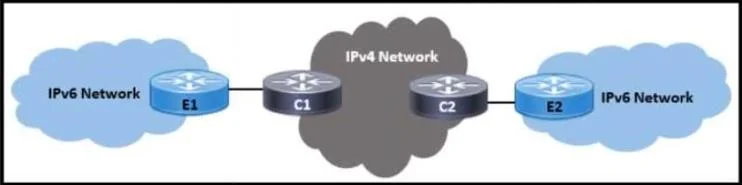
Refer to the exhibit. An architect is designing an ISIS network for a customer migrating from IPv4 to IPv6. The current network uses narrow metrics, and the IPv6 areas will increase to 10 within the…
The correct answer is A. metric-style transition enabled on C1 and C2 D. multi-topology enabled under address-family ipv6 on C1 and C2. To migrate an ISIS network from IPv4 to IPv6, ensuring no blackholing and accommodating future growth, the architect must enable metric-style transition on core routers C1 and C2, and multi-topology for IPv6 on those same core routers.
Question
Refer to the exhibit. An architect is designing an ISIS network for a customer migrating from IPv4 to IPv6. The current network uses narrow metrics, and the IPv6 areas will increase to 10 within the next two years. Also, IPv6 traffic must not blackhole in IPv4 network during the migration. Which two solutions must the architect choose? (Choose two.)
Exhibit
Options
- Ametric-style transition enabled on C1 and C2
- Bmetric-style transition enabled on all routers
- Cmulti-topology enabled under address-family ipv6 on E1 and E2
- Dmulti-topology enabled under address-family ipv6 on C1 and C2
- Emetric-style transition enabled on E1 and E2
How the community answered
(48 responses)- A69% (33)
- B4% (2)
- C19% (9)
- E8% (4)
Why each option
To migrate an ISIS network from IPv4 to IPv6, ensuring no blackholing and accommodating future growth, the architect must enable `metric-style transition` on core routers C1 and C2, and `multi-topology` for IPv6 on those same core routers.
Enabling `metric-style transition` on core routers C1 and C2 is crucial for a graceful migration from narrow to wide ISIS metrics. This allows both metric styles to be advertised simultaneously, facilitating a smooth transition across the ISIS domain.
While `metric-style transition` should ideally be enabled on all ISIS routers for a complete domain-wide migration, selecting 'all routers' as a single solution doesn't satisfy the 'choose two' requirement, and C1/C2 represent key backbone points for this transition.
While edge routers E1 and E2 may eventually need MT-ISIS for IPv6, enabling it on the core or backbone routers (C1/C2) is more fundamental for ensuring network-wide IPv6 routing and preventing blackholing during migration.
Multi-Topology ISIS (MT-ISIS) is essential for running independent routing topologies for IPv4 and IPv6. Enabling `multi-topology` under `address-family ipv6` on core routers C1 and C2 ensures IPv6 routing is correctly established and prevents IPv6 traffic from being blackholed in the IPv4 network during migration.
Enabling `metric-style transition` only on edge routers E1 and E2 is a partial application and less impactful for the overall backbone metric transition compared to enabling it on core routers C1 and C2.
Concept tested: ISIS migration- IPv4 to IPv6, metric-style transition, multi-topology
Source: https://www.cisco.com/c/en/us/td/docs/ios-xml/ios/iproute_isis/configuration/xe-3s/irs-xe-3s-book/irs-config-isis.html
Topics
Community Discussion
No community discussion yet for this question.