
300-420 · Question #314
Refer to the exhibit. An engineer is designing an OSPF solution with these requirements: - NMS server will manage R5 and R6. - Upon failure of R1, all NMS traffic should be routed through R4. - Upon…
The correct answer is A. Redistribute OSPF process 1 into process 2 on R1 and R4. To provide redundancy for NMS traffic and specific host reachability, the engineer should implement OSPF multi-process with redistribution between R1 and R4.
Question
Refer to the exhibit. An engineer is designing an OSPF solution with these requirements:
- NMS server will manage R5 and R6.
- Upon failure of R1, all NMS traffic should be routed through R4.
- Upon failure of the link between R5 and R6, all traffic destined for
10.6.6.6 should be routed through R4. Which solution must the engineer choose?
Exhibit
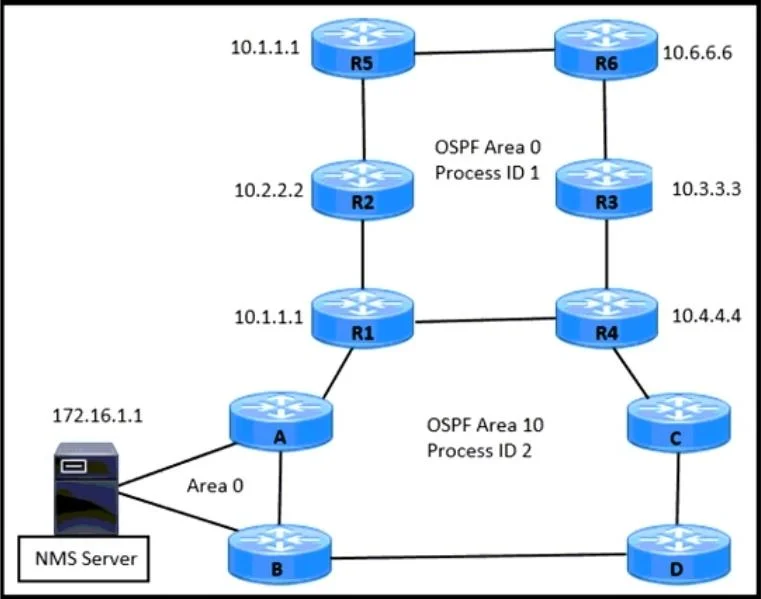
Options
- ARedistribute OSPF process 1 into process 2 on R1 and R4.
- BAdvertise 172.16.1.1 into OSPF process 1 with high cost on R1.
- CApply static routes on R2 and R3 with IP SLA tracking toward R5 and R6.
- DEnable the default-information originate command with a higher metric on R2 to R1.
How the community answered
(20 responses)- A80% (16)
- B5% (1)
- C5% (1)
- D10% (2)
Why each option
To provide redundancy for NMS traffic and specific host reachability, the engineer should implement OSPF multi-process with redistribution between R1 and R4.
By running two OSPF processes and redistributing routes between them on R1 and R4, path preferences can be controlled through metrics and administrative distance, enabling traffic to automatically failover to R4 if R1 or its primary paths fail, meeting the specific rerouting requirements.
Advertising a single IP with a high cost on R1 does not provide comprehensive rerouting for all NMS traffic or the specific destination 10.6.6.6 upon various failure scenarios.
Using static routes with IP SLA tracking on R2 and R3 would be overly complex to manage and scale for multiple failure conditions and specific destination routing requirements, compared to a dynamic OSPF solution.
Enabling `default-information originate` with a higher metric on R2 to R1 primarily controls default route advertisement, which does not address the granular rerouting needs for specific NMS traffic or the 10.6.6.6 destination.
Concept tested: OSPF multi-process redistribution for redundancy
Source: https://www.cisco.com/c/en/us/support/docs/ip/open-shortest-path-first-ospf/7039-1.html#anc11
Topics
Community Discussion
No community discussion yet for this question.