
300-420 · Question #3
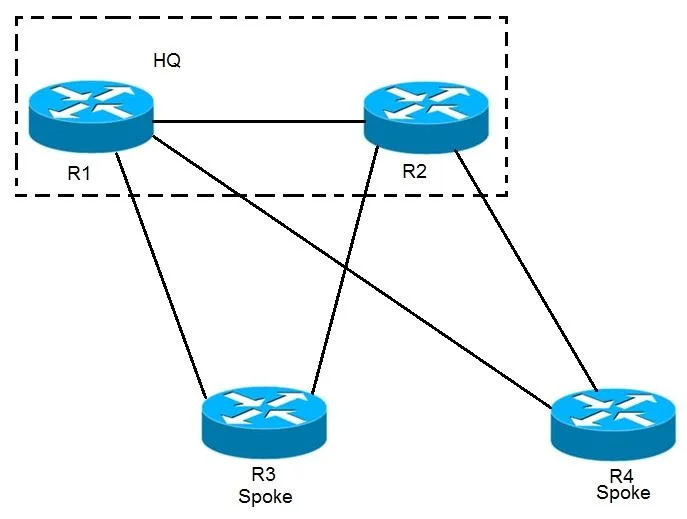
Refer to the exhibit. EIGRP has been configured on all links. The spoke nodes have been configured as EIGRP stubs, and the WAN links to R3 have higher bandwidth and lower delay than the links to R4…
The correct answer is A. R1 has no route to R2 and drops the traffic. EIGRP stub routers (R3 and R4 in this topology) only advertise their directly connected or summarized routes to the hub. They do not advertise routes learned from other EIGRP neighbors, meaning they will never advertise R2's subnets to R1. When the R1-R2 direct link fails, R1…
Question
Refer to the exhibit. EIGRP has been configured on all links. The spoke nodes have been configured as EIGRP stubs, and the WAN links to R3 have higher bandwidth and lower delay than the links to R4. When a link failure occurs at the R1-R2 link, what happens to traffic on R1 that is destined for a subnet attached to R2?
Exhibit
Options
- AR1 has no route to R2 and drops the traffic
- BR1 load-balances across the paths through R3 and R4 to reach R2
- CR1 forwards the traffic to R3, but R3 drops the traffic
- DR1 forwards the traffic to R3 in order to reach R2
How the community answered
(66 responses)- A79% (52)
- B12% (8)
- C6% (4)
- D3% (2)
Explanation
EIGRP stub routers (R3 and R4 in this topology) only advertise their directly connected or summarized routes to the hub. They do not advertise routes learned from other EIGRP neighbors, meaning they will never advertise R2's subnets to R1. When the R1-R2 direct link fails, R1 cannot learn about R2's subnets through R3 or R4 because stub routers suppress those advertisements. Therefore, R1 has no route to R2's subnets and drops the traffic. Even though the WAN links through R3 have better metrics, the stub configuration prevents those paths from being used as alternates to reach R2.
Community Discussion
No community discussion yet for this question.