
300-420 · Question #256
Refer to the exhibit. A customer has two eBGP peerings from a single CE router toward two service providers. The customer has hired an architect to design a solution to ensure certain traffic enters…
The correct answer is A. Break aggregated routes into longer prefixes and advertise to the preferred service provider. To ensure certain inbound traffic enters a customer's network via a preferred eBGP peering, the architect must advertise more specific routes to the preferred service provider.
Question
Refer to the exhibit. A customer has two eBGP peerings from a single CE router toward two service providers. The customer has hired an architect to design a solution to ensure certain traffic enters the customer’s network through interface gig0/0. Which solution must the architect include in the design?
Exhibit
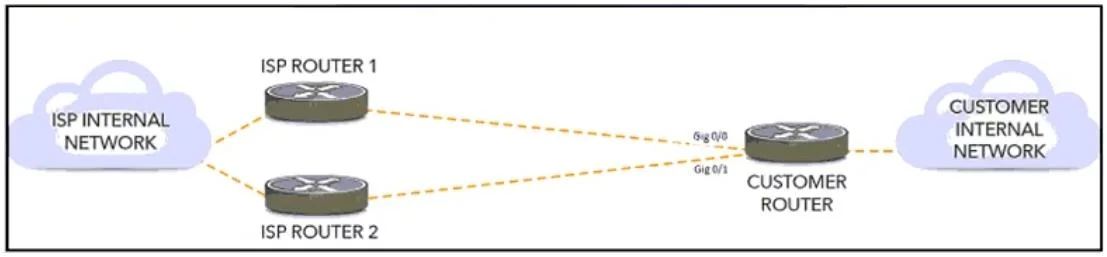
Options
- ABreak aggregated routes into longer prefixes and advertise to the preferred service provider.
- BAdvertise a lower MED value toward the less preferred service provider.
- CPrepend additional AS on the AS path toward the preferred service provider.
- DSet a higher local preference to the preferred service provider path.
How the community answered
(36 responses)- A83% (30)
- B3% (1)
- C11% (4)
- D3% (1)
Why each option
To ensure certain inbound traffic enters a customer's network via a preferred eBGP peering, the architect must advertise more specific routes to the preferred service provider.
BGP's path selection process prioritizes routes with the longest prefix match. By breaking aggregated routes into more specific (longer) prefixes and advertising these to the preferred service provider, external networks will see and choose these paths as more optimal to reach the customer's network via that specific provider, thus influencing inbound traffic flow.
MED (Multi-Exit Discriminator) influences how other ASes enter your AS, with a lower MED being preferred; advertising a lower MED to the *less preferred* service provider would encourage traffic through the non-preferred path.
AS path prepending makes a path appear longer and thus less preferred; prepending additional ASes on the AS path toward the *preferred* service provider would discourage inbound traffic from using that path.
Local Preference is a BGP attribute used to influence *outbound* traffic from your AS to choose a specific exit path and has no effect on how external ASes route traffic *into* your network.
Concept tested: BGP inbound traffic engineering with prefix specificity
Source: https://www.cisco.com/c/en/us/td/docs/ios-xml/ios/iproute_bgp/configuration/xe-16/irg-xe-16-book/bgp-inbound-traffic-engineering.html
Topics
Community Discussion
No community discussion yet for this question.