
300-420 · Question #250
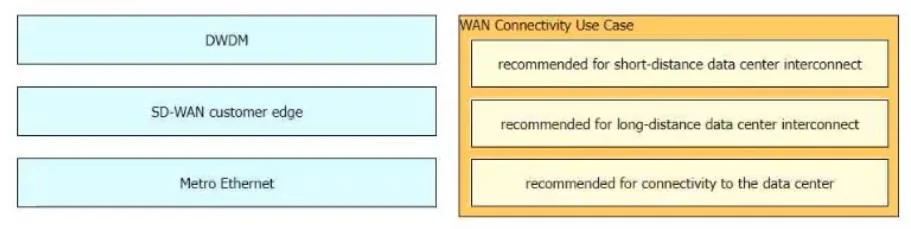
Drag and Drop Question Drag and drop the types of WAN connectivity from the left onto the connectivity use cases on the right. Answer:
The correct answer is Metro Ethernet; DWDM; SD-WAN customer edge. The question tests knowledge of various Wide Area Network (WAN) connectivity technologies and their appropriate use cases for data center interconnects and general data center access.
Question
Drag and Drop Question Drag and drop the types of WAN connectivity from the left onto the connectivity use cases on the right. Answer:
Exhibit
Answer Area
Drag items
Correct arrangement
- Metro Ethernet
- DWDM
- SD-WAN customer edge
Explanation
The question tests knowledge of various Wide Area Network (WAN) connectivity technologies and their appropriate use cases for data center interconnects and general data center access.
Approach. Based on the second exhibit image, the correct drag-and-drop pairings are:
-
Metro Ethernet is dragged to 'recommended for short-distance data center interconnect'.
- Reasoning: Metro Ethernet provides high-bandwidth, cost-effective Layer 2 connectivity over a metropolitan area. It's ideal for connecting data centers or enterprise sites within the same city or regional footprint due to its efficiency and lower latency over shorter distances.
-
DWDM is dragged to 'recommended for long-distance data center interconnect'.
- Reasoning: Dense Wavelength Division Multiplexing (DWDM) is an optical technology that enables multiple high-capacity data streams over a single fiber optic cable using different wavelengths of light. It's designed for very high bandwidth, long-haul (long-distance) transmissions, making it suitable for intercontinental or long-distance data center interconnects where massive data volumes need to be moved.
-
SD-WAN customer edge is dragged to 'recommended for connectivity to the data center'.
- Reasoning: A Software-Defined Wide Area Network (SD-WAN) architecture, particularly the customer edge device, is primarily used to connect branch offices, remote sites, or individual user locations to centralized resources like data centers or cloud services. It optimizes traffic routing, provides resilience, and often uses multiple underlying transport services (e.g., broadband internet, MPLS) to ensure efficient and reliable 'connectivity to' the data center.
Common mistakes.
- common_mistake. Common mistakes often involve confusing the distance applicability of Metro Ethernet and DWDM, or misinterpreting the primary role of an SD-WAN customer edge device. For example:
- Dragging DWDM to 'short-distance data center interconnect': This is incorrect because DWDM is primarily used for long-haul, high-capacity links over significant distances, not short-distance interconnects which are better served by Metro Ethernet due to cost and operational complexity.
- Dragging Metro Ethernet to 'long-distance data center interconnect': This is incorrect as Metro Ethernet is geographically limited, typically to a metropolitan area. While it can connect multiple sites, it's not designed for the very long-distance, high-capacity requirements that DWDM fulfills.
- Dragging SD-WAN customer edge to 'short-distance' or 'long-distance data center interconnect': While SD-WAN can leverage underlying transport mechanisms that span various distances, its primary function, especially the 'customer edge' component, is to provide optimized and resilient 'connectivity to' a data center from distributed enterprise locations, rather than serving as the direct point-to-point interconnect between data centers themselves (which DWDM or Metro Ethernet would provide).
Concept tested. WAN connectivity technologies, their characteristics (bandwidth, distance, typical use cases), and their application in data center networking and enterprise connectivity.
Topics
Community Discussion
No community discussion yet for this question.