
300-420 · Question #235
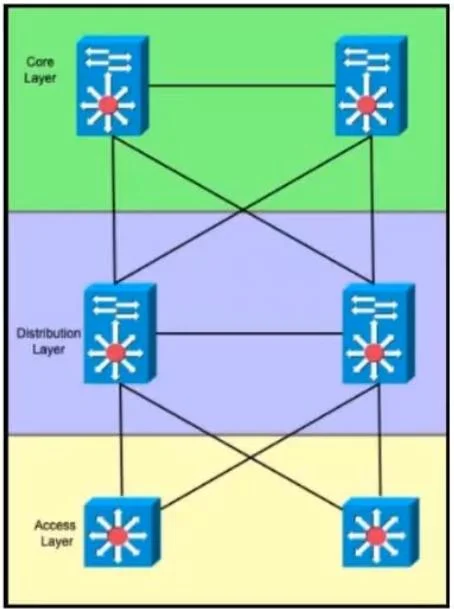
Refer to the exhibit. An engineer is designing a multicampus Layer 3 infrastructure using EIGRP as the routing protocol. The design must provide quick replies to queries in the event of a downlink…
The correct answer is C. Configure distribution layer switches to summarize routes to the core layer. D. Configure access layer switches as stub routers. To optimize EIGRP in a multicampus design, configuring access layer switches as stub routers contains queries, and summarizing routes from distribution layer switches to the core layer reduces routing table size and enhances stability.
Question
Refer to the exhibit. An engineer is designing a multicampus Layer 3 infrastructure using EIGRP as the routing protocol. The design must provide quick replies to queries in the event of a downlink, prevent unnecessary queries, and ensure that traffic does not unnecessarily transit the access layer. Which two actions must the engineer take for the network design? (Choose two.)
Exhibit
Options
- AConfigure core layer switches as stub routers.
- BConfigure access layer and core layer switches as stub routers.
- CConfigure distribution layer switches to summarize routes to the core layer.
- DConfigure access layer switches as stub routers.
- EConfigure access layer switches to summarize routes to the distribution layer.
How the community answered
(23 responses)- A9% (2)
- B4% (1)
- C74% (17)
- E13% (3)
Why each option
To optimize EIGRP in a multicampus design, configuring access layer switches as stub routers contains queries, and summarizing routes from distribution layer switches to the core layer reduces routing table size and enhances stability.
Configuring core layer switches as stub routers is incorrect because the core is designed to provide full reachability and propagate routes across the entire network, not act as an endpoint that restricts query propagation.
Configuring both access and core layers as stub routers is inappropriate for the core layer, as it would hinder the core's ability to propagate necessary routes.
Configuring distribution layer switches to summarize routes to the core layer reduces the number of routes propagated upstream, which decreases the core routing table size and limits the scope of EIGRP queries, improving convergence and stability.
Configuring access layer switches as EIGRP stub routers prevents EIGRP queries from propagating into the access layer, thereby limiting the query scope, reducing CPU utilization on access layer devices, and speeding up convergence throughout the network.
Access layer switches typically advertise directly connected networks and are best configured as stubs to limit query scope; route summarization is usually performed at higher aggregation points like the distribution layer.
Concept tested: EIGRP stub routing and route summarization
Source: https://www.cisco.com/c/en/us/td/docs/ios/iproute_eigrp/configuration/guide/ire_config/ire_cfg_ch1.html
Topics
Community Discussion
No community discussion yet for this question.