
300-420 · Question #223
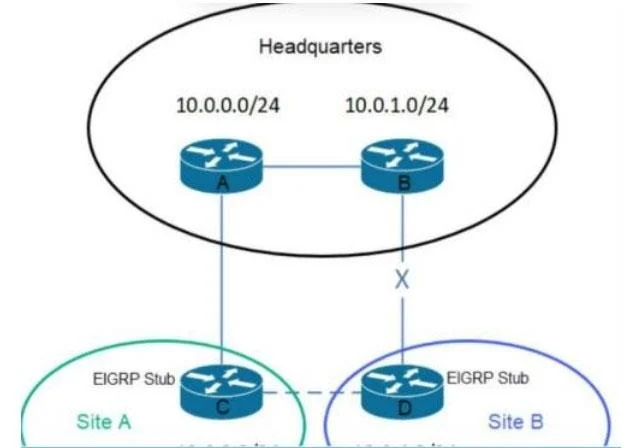
Refer to the exhibit. An architect is designing a routing solution for a company. The new design will add a circuit routers C and D to protect against loss of connectivity to 10.0.4.0/24 during a…
The correct answer is D. Stub leak-map. In this scenario, routers C and D are EIGRP stub routers (circuit routers) connected to the edge of the network. Normally, stub routers do not advertise routes received from other EIGRP neighbors - they only advertise their connected or summary routes. However, the network…
Question
Refer to the exhibit. An architect is designing a routing solution for a company. The new design will add a circuit routers C and D to protect against loss of connectivity to 10.0.4.0/24 during a link failure between routers B and D. Which solution must the architect choose?
Exhibit
Options
- AStub connected
- BStub redistributed
- CStub receive-only
- DStub leak-map
How the community answered
(29 responses)- A7% (2)
- B3% (1)
- C10% (3)
- D79% (23)
Explanation
In this scenario, routers C and D are EIGRP stub routers (circuit routers) connected to the edge of the network. Normally, stub routers do not advertise routes received from other EIGRP neighbors - they only advertise their connected or summary routes. However, the network needs router C or D to advertise the 10.0.4.0/24 prefix to protect against a failure between routers B and D. The 'stub leak-map' option allows an EIGRP stub router to selectively advertise specific routes (defined in a route-map) that would otherwise be suppressed by the stub configuration. This gives the design the protection of a stub (preventing suboptimal routing and query propagation) while still allowing targeted route advertisement for resilience. Stub connected (A) only advertises connected routes. Stub redistributed (B) advertises redistributed routes. Stub receive-only (C) advertises nothing - the most restrictive option and opposite of what is needed here.
Topics
Community Discussion
No community discussion yet for this question.