
300-420 · Question #220
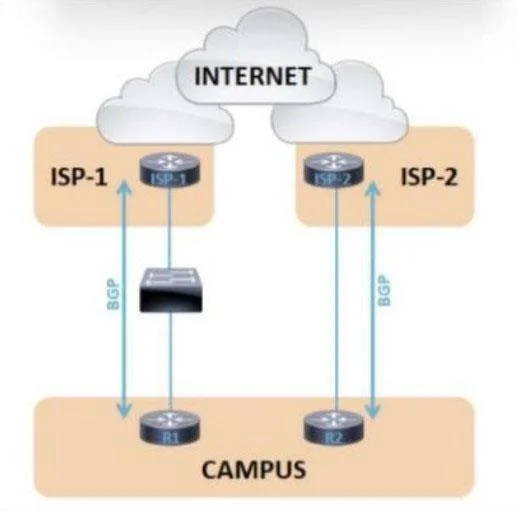
Refer to the exhibit. The failover time of ISP-2 is significantly shorter than ISP-1 when an interface on the ISP router toward the campus network fails. Which solution minimizes the downtime to the…
The correct answer is D. BFD. BFD (Bidirectional Forwarding Detection) is the correct solution for achieving sub-second failure detection. BFD is a lightweight hello protocol that runs at very short intervals (as low as 50ms) between directly connected peers and operates independently of the control plane…
Question
Refer to the exhibit. The failover time of ISP-2 is significantly shorter than ISP-1 when an interface on the ISP router toward the campus network fails. Which solution minimizes the downtime to the sub-second?
Exhibit
Options
- AAggressive timers
- BNext-hop address tracking
- CGraceful-restart
- DBFD
How the community answered
(22 responses)- B5% (1)
- D95% (21)
Explanation
BFD (Bidirectional Forwarding Detection) is the correct solution for achieving sub-second failure detection. BFD is a lightweight hello protocol that runs at very short intervals (as low as 50ms) between directly connected peers and operates independently of the control plane, often in the data plane or hardware. When a link fails, BFD detects it in milliseconds and immediately notifies BGP to withdraw the affected routes and trigger reconvergence. In contrast, aggressive BGP timers (A) can reduce hold timers to a few seconds but cannot reliably achieve sub-second detection. Next-hop address tracking (B) reacts to changes in the RIB for BGP next-hops but depends on IGP convergence, which can take longer. Graceful restart (C) is designed to maintain forwarding state during a control plane restart and does not speed up failure detection - it is used for planned maintenance, not fast failover.
Topics
Community Discussion
No community discussion yet for this question.