
300-420 · Question #164
Refer to the exhibit. An architect must design a solution to connect the two ASs. To optimize bandwidth, the design will implement load sharing between router R6 and router R4. Which solution should…
The correct answer is D. Use maximum-paths to install multiple paths in the routing table. The architect needs to design a solution that enables load sharing between two routers connecting different ASs using eBGP to optimize bandwidth.
Question
Refer to the exhibit. An architect must design a solution to connect the two ASs. To optimize bandwidth, the design will implement load sharing between router R6 and router R4. Which solution should the design include?
Exhibit
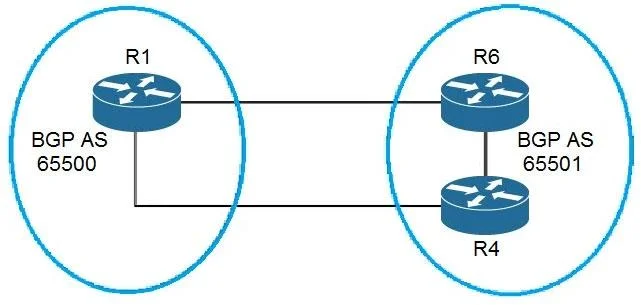
Options
- AUse update-source to specify the Loopback interface.
- BUse next-hop-serf attributes only for routes that are learned from eBGP peers.
- CConfigure the eBGP TTL to support eBGP multihop.
- DUse maximum-paths to install multiple paths in the routing table.
How the community answered
(30 responses)- A13% (4)
- B7% (2)
- C3% (1)
- D77% (23)
Why each option
The architect needs to design a solution that enables load sharing between two routers connecting different ASs using eBGP to optimize bandwidth.
Using `update-source` with a Loopback interface is a best practice for iBGP peerings to ensure BGP session stability and reachability, but it does not enable load sharing across eBGP paths.
The attribute is `next-hop-self`, not `next-hop-serf`, and it is typically used for iBGP peers to ensure reachability to external networks, not for load sharing between eBGP peers.
Configuring eBGP multihop by increasing the TTL (Time-to-Live) allows eBGP peers to be more than one hop away, which is useful for non-directly connected peers, but it does not enable load sharing across multiple paths.
The `maximum-paths` command in BGP allows a router to install multiple paths for the same destination prefix into the routing table, enabling load sharing across these parallel eBGP connections. This directly addresses the requirement to optimize bandwidth by distributing traffic over multiple links between R6 and R4.
Concept tested: BGP load sharing with maximum-paths
Source: https://www.cisco.com/c/en/us/td/docs/ios/iproute_bgp/configuration/guide/irg_multipath_bgp.html
Topics
Community Discussion
No community discussion yet for this question.