
300-420 · Question #158
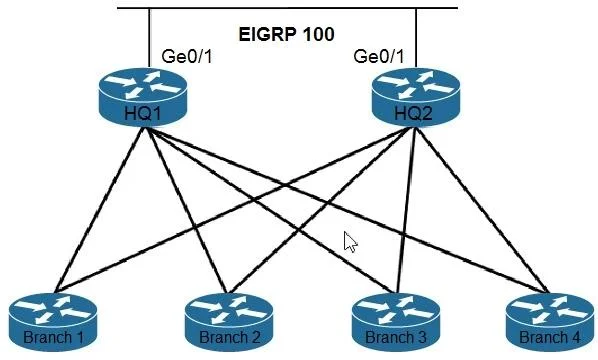
Refer to the exhibit. An architect must create a stable and scalable EIGRP solution for a customer. The design must: - conserve bandwidth, memory, and CPU processing - prevent suboptimal routing…
The correct answer is B. Stub routing D. Route summarization. Stub Routing (B) and Route Summarization (D) together address all three design goals. Stub routing designates routers (typically branch/hub-and-spoke endpoints) as stubs, which tells EIGRP neighbors not to send them Query messages for routes they do not advertise. This directly…
Question
Refer to the exhibit. An architect must create a stable and scalable EIGRP solution for a customer. The design must:
- conserve bandwidth, memory, and CPU processing
- prevent suboptimal routing
- avoid any unnecessary queries
Which two solutions must the architect select? (Choose two.)
Exhibit
Options
- APrefix lists
- BStub routing
- CDistribute lists
- DRoute summarization
- EStatic redistribution
How the community answered
(40 responses)- A5% (2)
- B70% (28)
- C15% (6)
- E10% (4)
Explanation
Stub Routing (B) and Route Summarization (D) together address all three design goals. Stub routing designates routers (typically branch/hub-and-spoke endpoints) as stubs, which tells EIGRP neighbors not to send them Query messages for routes they do not advertise. This directly conserves bandwidth, reduces CPU/memory load during topology changes, and limits the Query propagation scope-preventing unnecessary queries. Route Summarization (D) reduces the size of routing tables (conserving memory), limits the scope of EIGRP Queries to within the summarization boundary (preventing queries from propagating beyond the summarizing router), and prevents suboptimal routing by keeping route information aggregated and stable. Prefix lists (A) and distribute lists (C) filter route advertisements but do not control Query propagation or reduce table size as efficiently. Static redistribution (E) introduces administrative complexity and does not address Query propagation or bandwidth conservation.
Topics
Community Discussion
No community discussion yet for this question.