
300-420 · Question #120
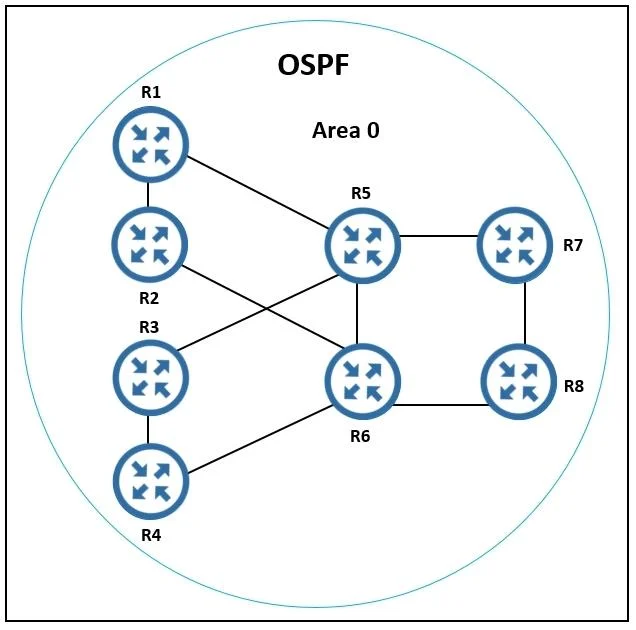
Refer to the exhibit. All routers currently reside in OSPF area 0. The network manager recently used R1 and R2 as aggregation routers for remote branch locations and R3 and R4 for aggregation…
The correct answer is B. a new OSPF area for R3 and R4 connections, with R5 and R6 as ABRs E. a new OSPF area for R1 and R2 connections, with R5 and R6 as ABRs. To enhance OSPF stability and minimize Area Border Routers (ABRs), new OSPF areas should be created for the aggregation routers R1/R2 and R3/R4, with the central routers R5 and R6 acting as the ABRs for these new areas.
Question
Refer to the exhibit. All routers currently reside in OSPF area 0. The network manager recently used R1 and R2 as aggregation routers for remote branch locations and R3 and R4 for aggregation routers for remote office locations. The network has since been suffering from outages, which are causing frequent SPF runs. To enhance stability and introduce areas to the OSPF network with the minimal number of ABRs possible, which two solutions should the network manager recommend? (Choose two.)
Exhibit
Options
- Aa new OSPF area for R1 and R2 connections, with R1 and R2 as ABRs
- Ba new OSPF area for R3 and R4 connections, with R5 and R6 as ABRs
- Ca new OSPF area for R3 and R4 connections, with R3 and R4 as ABRs
- Da new OSPF area for R1, R2, R3, and R4 connections, with R1, R2, R3, and R4 as ABRs
- Ea new OSPF area for R1 and R2 connections, with R5 and R6 as ABRs
How the community answered
(47 responses)- A4% (2)
- B64% (30)
- C11% (5)
- D21% (10)
Why each option
To enhance OSPF stability and minimize Area Border Routers (ABRs), new OSPF areas should be created for the aggregation routers R1/R2 and R3/R4, with the central routers R5 and R6 acting as the ABRs for these new areas.
Making R1 and R2 ABRs would increase the total number of ABRs in the network compared to centralizing the ABR function on R5 and R6, which contradicts the goal of minimizing ABRs.
Creating a new OSPF area for R3 and R4 connections with R5 and R6 as ABRs allows R3/R4 to localize their SPF runs within their new area, while R5/R6 serve as central ABRs connecting this area to Area 0.
Making R3 and R4 ABRs would also increase the total number of ABRs, failing to meet the requirement for the minimal number of ABRs.
Creating a single large new OSPF area for R1, R2, R3, and R4 with all of them as ABRs would not minimize the ABR count and could potentially make the new area too large, defeating the purpose of area segregation for localized SPF runs.
Creating a new OSPF area for R1 and R2 connections with R5 and R6 as ABRs similarly localizes SPF runs for R1/R2. By having R5 and R6 act as ABRs for both new areas, the total number of ABRs is minimized as requested.
Concept tested: OSPF area design and ABR placement
Source: https://www.cisco.com/c/en/us/td/docs/ios-xml/ios/iproute_ospf/configuration/15-s/iro-15-s-book/iro-cfg.html
Topics
Community Discussion
No community discussion yet for this question.