
300-420 · Question #105
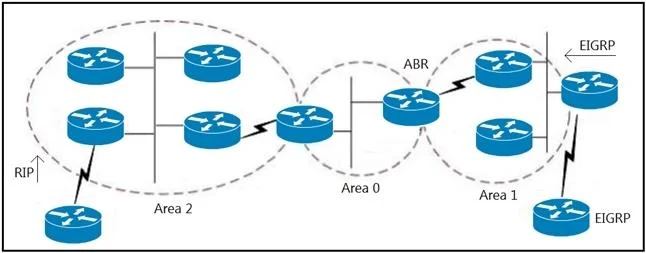
Refer to the exhibit. An engineer is designing an OSPF network for a client. Requirements dictate that the routers in Area 1 should receive all routes belonging to the network, including EIGRP…
The correct answer is A. Make area 1 a NSSA. A Not-So-Stubby Area (NSSA) is the correct solution. A standard stub area blocks all external routes (Type 5 LSAs), which would also block the EIGRP routes - violating the requirement. A standard OSPF area accepts all external routes including RIP, which also violates the…
Question
Refer to the exhibit. An engineer is designing an OSPF network for a client. Requirements dictate that the routers in Area 1 should receive all routes belonging to the network, including EIGRP, except the ones originated in the RIP domain. Which action should the engineer take?
Exhibit
Options
- AMake area 1 a NSSA.
- BMake area 1 a stub.
- CMake area 1 a standard OSPF area.
- DMake the area 1 routers part of area 0.
How the community answered
(40 responses)- A68% (27)
- B10% (4)
- C18% (7)
- D5% (2)
Explanation
A Not-So-Stubby Area (NSSA) is the correct solution. A standard stub area blocks all external routes (Type 5 LSAs), which would also block the EIGRP routes - violating the requirement. A standard OSPF area accepts all external routes including RIP, which also violates the requirement. Making Area 1 routers part of Area 0 changes the topology unnecessarily. An NSSA blocks incoming Type 5 LSAs (which carry RIP external routes redistributed at the backbone ABR) while still allowing external routes redistributed directly at the NSSA ABR to enter as Type 7 LSAs. If EIGRP is redistributed at the NSSA boundary, those routes propagate into Area 1, while RIP routes originating from a different OSPF external injection point are blocked by the NSSA behavior.
Topics
Community Discussion
No community discussion yet for this question.