
300-420 · Question #101
Refer to the exhibit. Customers report low video quality and delays when having point-to-point telepresence video calls between the two locations. An architect must optimize a design so that traffic…
The correct answer is A. Configure route leaking on the router in area 2. Telepresence calls require symmetric routing - packets must follow the same physical path in both directions to minimize jitter and delay asymmetry. In multi-area OSPF, Type 3 summary LSAs can obscure the true topology, causing ingress and egress paths to diverge. Route leaking…
Question
Refer to the exhibit. Customers report low video quality and delays when having point-to-point telepresence video calls between the two locations. An architect must optimize a design so that traffic follows the same path for egress and ingress traffic flows. Which technique optimizes the design?
Exhibit
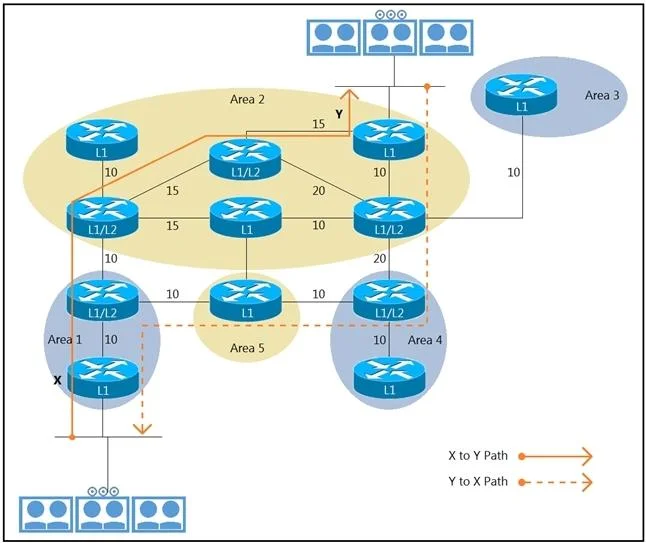
Options
- AConfigure route leaking on the router in area 2.
- BConfigure route leaking on he router in area 1.
- CConfigure the high metric on the router in area 4.
- DConfigure route filter on the router in area 4.
How the community answered
(32 responses)- A53% (17)
- B13% (4)
- C25% (8)
- D9% (3)
Explanation
Telepresence calls require symmetric routing - packets must follow the same physical path in both directions to minimize jitter and delay asymmetry. In multi-area OSPF, Type 3 summary LSAs can obscure the true topology, causing ingress and egress paths to diverge. Route leaking on the ABR in area 2 injects more specific inter-area routes into the topology, giving routers in other areas enough detail to make routing decisions that produce symmetric paths. Without this, routers rely on summary routes that may result in traffic taking different physical paths in each direction, degrading video quality. Route leaking on area 1 (option B) or metric/filter changes on area 4 (options C/D) would not address the asymmetry at the area 2 boundary.
Topics
Community Discussion
No community discussion yet for this question.