
300-370 · Question #41
Refer to the exhibit. A new wireless deployment with high AP density is experiencing high latency and connectivity issues on the 24 GHz band, despite an initial site survey done by a certified…
The correct answer is C. Disable lower data rate, such as 1 Mbps and 2 Mbps. In a high-density 2.4 GHz deployment with latency and connectivity issues, disabling lower data rates (e.g., 1 and 2 Mbps) is the most impactful change. This forces clients to use higher, more efficient data rates, improving overall network performance and airtime utilization.
Question
Refer to the exhibit. A new wireless deployment with high AP density is experiencing high latency and connectivity issues on the 24 GHz band, despite an initial site survey done by a certified partner. Which option is the most impactful change a wireless consultant recommends?
Exhibit
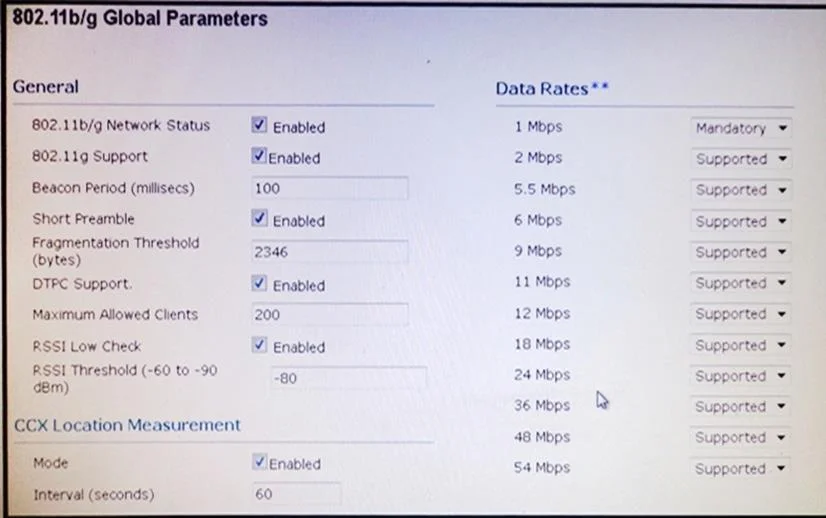
Options
- AIncrease the fragmentation threshold to allow larger packets over the air.
- BReduce the beacon period because it reduces the RF interference.
- CDisable lower data rate, such as 1 Mbps and 2 Mbps.
- DDisable the short preamble.
- EDisable 80211g support to reduce interference.
How the community answered
(53 responses)- A2% (1)
- B9% (5)
- C81% (43)
- D6% (3)
- E2% (1)
Why each option
In a high-density 2.4 GHz deployment with latency and connectivity issues, disabling lower data rates (e.g., 1 and 2 Mbps) is the most impactful change. This forces clients to use higher, more efficient data rates, improving overall network performance and airtime utilization.
Increasing the fragmentation threshold allows larger packets, but this might not resolve issues in a congested environment; smaller packets due to a lower threshold can sometimes be more resilient to interference, so increasing it might worsen issues.
Reducing the beacon period increases the frequency of beacons, which consumes more airtime and could increase RF interference and overhead, worsening the problem rather than reducing it.
Disabling lower data rates, such as 1 Mbps and 2 Mbps, forces wireless clients to associate and communicate at higher, more efficient data rates. In a high-density environment, lower data rates consume significantly more airtime for the same amount of data, leading to increased contention, latency, and overall network congestion, especially on the crowded 2.4 GHz band.
Disabling the short preamble and forcing long preamble would typically increase overhead and consume more airtime, which is counterproductive in a high-density environment experiencing latency and connectivity issues. Short preambles are generally preferred for efficiency.
Disabling 802.11g support would prevent 802.11g clients from connecting and force 802.11b-only operation, which uses even lower data rates and is highly inefficient, exacerbating the issues on the 2.4 GHz band.
Concept tested: Optimizing 2.4 GHz WLAN in high density
Source: https://www.cisco.com/c/en/us/td/docs/solutions/Enterprise/Wireless/wlan_design_guide/8_0/WLAN_Design_Guide_8_0_chapter7.html
Topics
Community Discussion
No community discussion yet for this question.