
300-370 · Question #28
Refer to the exhibit. A mobile station in a factory contains an AP configured as a work group bridge that authenticates to a root AP using EAP-FAST. To be able to use the mobile station in further…
The correct answer is A. RAP1 is using a different authentication protocol than RAP2. A roaming failure where a workgroup bridge authenticates to one root AP but not another, despite both being configured for EAP-FAST, indicates an underlying functional difference in their EAP-FAST protocol implementation or configuration.
Question
Refer to the exhibit. A mobile station in a factory contains an AP configured as a work group bridge that authenticates to a root AP using EAP-FAST. To be able to use the mobile station in further parts of the factory, another root AP is installed and also configured for EAP-FAST When the mobile station is attempting to roam to the other AP, it loses connection yet can still authenticate to the first one. What is the cause for the failed authentication on RAP2?
Exhibit
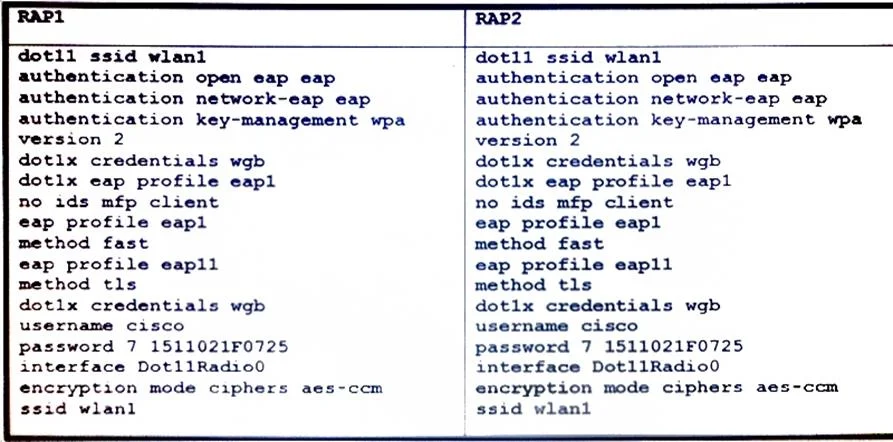
Options
- ARAP1 is using a different authentication protocol than RAP2.
- BRAP2 has a different SSID than RAP1.
- CRAP1 is using a different encryption than RAP2.
- DThe authentication usemame and password is different.
How the community answered
(28 responses)- A68% (19)
- B4% (1)
- C21% (6)
- D7% (2)
Why each option
A roaming failure where a workgroup bridge authenticates to one root AP but not another, despite both being configured for EAP-FAST, indicates an underlying functional difference in their EAP-FAST protocol implementation or configuration.
Although both RAPs are configured for EAP-FAST, the successful authentication with RAP1 and subsequent failure with RAP2 implies a mismatch in their specific EAP-FAST parameters or how they interact with the authentication server. This functional difference, such as mismatched Protected Access Credentials (PACs) or inconsistent backend server policies for RAP2, effectively makes the 'protocol' behave differently for the workgroup bridge.
If RAP2 had a different SSID, the mobile station configured as a workgroup bridge would likely not attempt to roam to it or would fail association, not just authentication.
EAP-FAST is an authentication protocol; while it establishes keys for encryption, a mismatch in the encryption type (e.g., AES vs. TKIP) is distinct from the authentication protocol itself and would manifest differently.
If the authentication username and password were truly different for the same workgroup bridge, it would likely fail authentication with RAP1 as well, assuming the WGB uses consistent credentials.
Concept tested: EAP-FAST authentication, Workgroup Bridge roaming, AP configuration consistency
Source: https://www.cisco.com/c/en/us/support/docs/security/identity-services-engine/116035-config-eapfast-00.html
Topics
Community Discussion
No community discussion yet for this question.