
300-365 · Question #84
Which option is a physical entity in converged access wireless network design?
The correct answer is D. mobility agent. In Cisco converged access architecture, the mobility agent is the only physical entity listed - it is an actual Catalyst switch running wireless mobility functions, while the other options are logical constructs.
Question
Which option is a physical entity in converged access wireless network design?
Exhibit
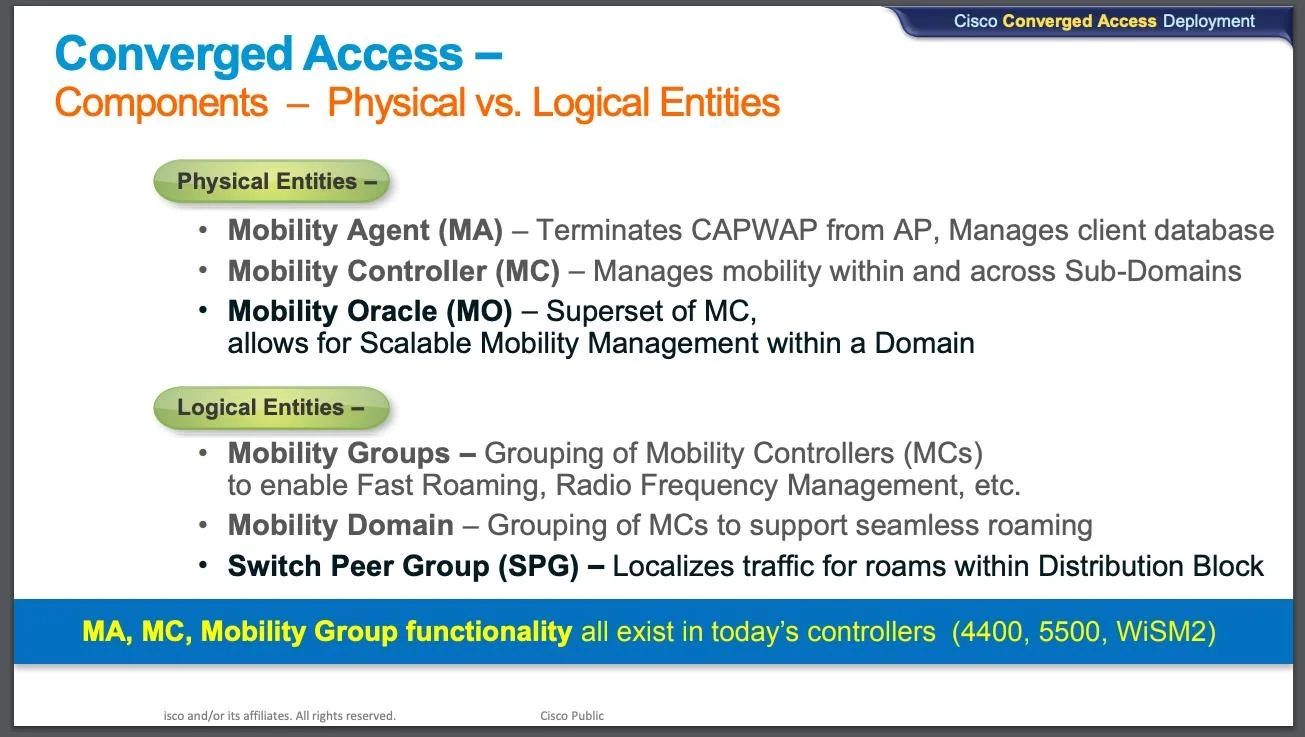
Options
- Amobility domain
- Bswitch peer group
- Cmobility group
- Dmobility agent
How the community answered
(27 responses)- B4% (1)
- C4% (1)
- D93% (25)
Why each option
In Cisco converged access architecture, the mobility agent is the only physical entity listed - it is an actual Catalyst switch running wireless mobility functions, while the other options are logical constructs.
A mobility domain is a logical grouping of mobility groups that share roaming and client information, not a physical hardware component.
A switch peer group is a logical construct grouping Catalyst switches together for high availability and redundancy purposes, not a physical entity.
A mobility group is a logical grouping of up to 24 WLCs that exchange client state to support seamless Layer 2 and Layer 3 roaming, not a physical device.
The mobility agent (MA) is a physical device - a Cisco Catalyst switch running IOS-XE with embedded WLC functionality - that handles AP association, client mobility, data forwarding, and CAPWAP tunneling for attached APs within the converged access design.
Concept tested: Converged access physical vs logical architecture components
Source: https://www.cisco.com/c/en/us/td/docs/solutions/Enterprise/Mobility/EMBD/convergedaccessDG/ConvergedAccessDesignGuide.html
Topics
Community Discussion
No community discussion yet for this question.